From pixels to pleasure: visual features explain dynamic aesthetic experiences across distinct movie content

From pixels to pleasure: visual features explain dynamic aesthetic experiences across distinct movie content
Ekinci, M. A.; Buhlmann, N.; Kaiser, D.
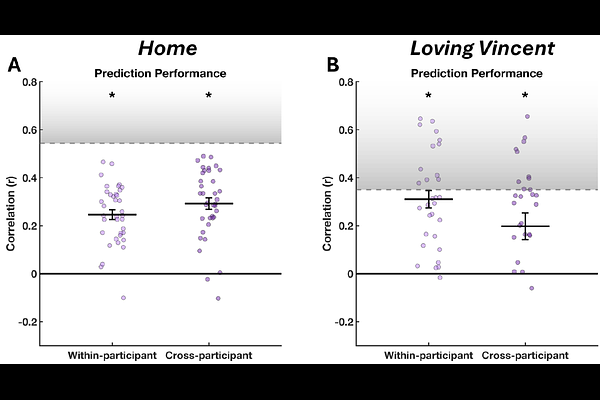
AbstractAesthetic experiences in everyday life unfold under continuously changing visual input. Although these experiences clearly depend on the observer and context, they are partly explained by the visual features of the input. Here, we investigated how well a combination of visual features predicts dynamic aesthetic experiences during naturalistic and artistic movie watching. In two experiments, participants continuously rated the aesthetic appeal of either the nature documentary Home or the animated art-style movie Loving Vincent. We modeled moment-to-moment ratings using image-computable visual features extracted from each movie frame, including visual fluency, color and motion statistics, and symmetry. Linear models trained on these features reliably predicted aesthetic ratings for new movie parts, both within and across observers, pointing to shared perceptual influences on aesthetic experiences. Model comparisons showed that visual fluency and color-related features were most informative for predicting aesthetic experience in both movies. Critically, models trained on one movie could reliably predict aesthetic appeal ratings in the other movie, despite the movies' remarkably different content and styles. Color features were most informative for cross-movie prediction. We conclude that visual features shape dynamic and naturalistic aesthetic experiences, and that the mapping of visual features onto aesthetic appeal is stable across observers and different movie content.