Self-supervised representations reveal the genetic architecture of human cortical folding

Self-supervised representations reveal the genetic architecture of human cortical folding
Dufournet, A. J.; Laval, J.; Chavas, J.; Fischer, C.; Riviere, D.; Frouin, V.; Mangin, J.-F.
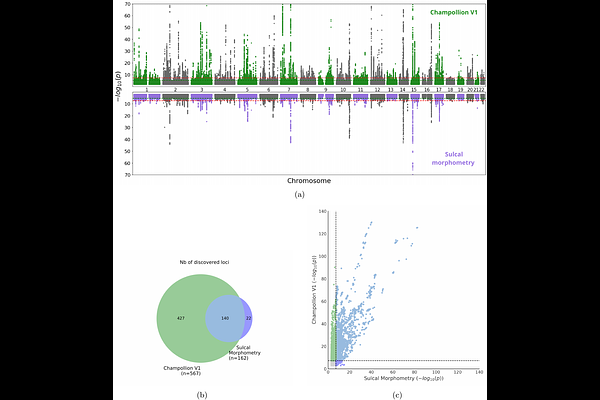
AbstractCortical folding emerges during fetal development, is under genetic control, and remains stable throughout life, offering a lasting window into early neurodevelopment. Conventional morphometric descriptors, however, only partially capture the shape variability of cortical folds. We apply multivariate genome-wide association studies (GWAS) to 56 region-wise representations of cortical folds generated by Champollion, a self-supervised learning framework, in 35,940 UK Biobank (UKB) participants, identifying 567 independent genome-wide significant loci, versus 162 for classical sulcal morphometry, 87% of which were also detected by our approach. More than half of these associations replicate in the independent Adolescent Brain Cognitive Development (ABCD) cohort. Gene, gene-set, BrainSpan and single cell expression enrichment converge on a shared prenatal window of neurogenesis and morphogenesis, and spatial gene-association maps recapitulate known regional expression gradients, including for NR2F1. Together, these results establish self-supervised representations of cortical folding as a powerful phenotype for the genetic study of neurodevelopment.