Behavioral hierarchy without a hierarchical brain

Behavioral hierarchy without a hierarchical brain
Han, Y.; Liu, Q.; Liu, S.; Cheng, H.; Wei, P.
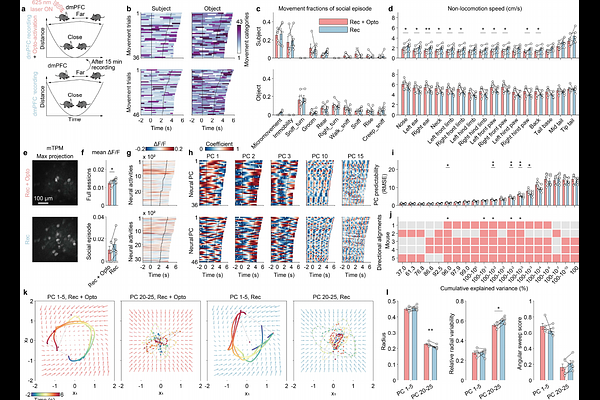
AbstractBehavior is inherently hierarchical. The prevailing view holds that hierarchical behavior arises from the brain's hierarchical organization. However, this view is primarily derived from experiments in highly controlled laboratory settings, and it remains unknown whether the same principles apply during natural, freely moving behavior. Here, we show that, under naturalistic and freely moving conditions, hierarchical mouse behavior can emerge from localized cortical dynamics alone, independent of anatomical or functional brain hierarchies. We first established a naturalistic neuroethological platform that enables quantitative characterization of hierarchical behavior alongside its corresponding neural activity. Using this platform, we find that localized cortical dynamics encode multiple levels of behavioral hierarchy. Specifically, low-dimensional neural dynamics encode high-level behavioral composites, whereas higher-dimensional neural dynamics encode low-level behavioral kinematics. Finally, by selectively perturbing high-dimensional components of cortical dynamics using optogenetics, we observe a selective reduction in low-level kinematic behaviors, providing causal evidence for this relationship. Together, these findings challenge a central assumption in systems neuroscience by demonstrating that hierarchical behavior does not require a hierarchically organized brain. Instead, hierarchy emerges from the dimensional organization of localized cortical dynamics, revealing a previously unrecognized principle by which complex behavior can arise from relatively simple neural substrates. This dynamic principle offers a unifying framework for understanding how biological systems achieve behavioral flexibility under natural conditions and suggests new directions for artificial intelligence that rely on adaptive local dynamics rather than increasingly deep architectures.