Semi-automated identification of southern right whales from drone imagery by classical image matching methods

Semi-automated identification of southern right whales from drone imagery by classical image matching methods
Fabry, B.; Jacobs, G.; Bartl, J.; Fabry, M.
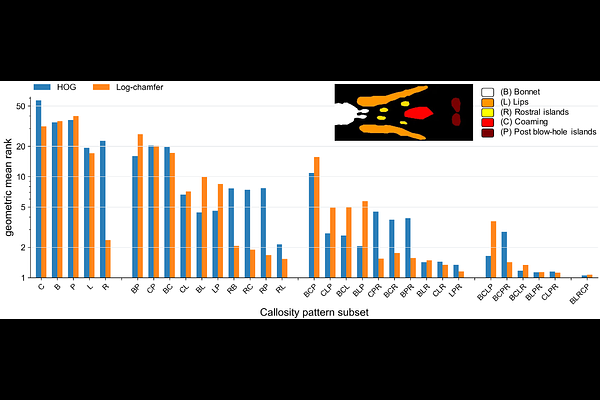
AbstractIndividual southern right whales (Eubalaena australis) can be identified from the callosity pattern on the head, a stable pattern of roughened keratinized patches. Manual comparison of drone images with large catalogs, however, is time-consuming. For southern right whales, automated photo-identification remains difficult to implement routinely in small or growing drone-based catalogs, because many approaches require substantial training data or retraining when new individuals are added. Here we evaluate two classical image-similarity methods for individual identification from standardized dorsal head images: histograms of oriented gradients (HOG) and a symmetric log-chamfer distance. We tested 375 query images from 198 known whales with recurrent sightings against 411 reference images of as many individual whales. HOG ranked the correct whale first in 361 of 375 cases (96.3%), whereas log-chamfer ranked the correct whale first in 355 cases (94.7%). All incorrect rank-1 matches could be identified by a high risk score computed from query-reference distance distributions. A combined rule selecting the first-ranked candidate from the method with the lower risk score increased rank-1 accuracy to 368 cases (98.1%). These results show that classical registered image matching provides a practical tool for southern right whale photo-identification.