Hippocampal and Midbrain Function in Superagers Relates to Memory for Novelty and Expectation Violation

Hippocampal and Midbrain Function in Superagers Relates to Memory for Novelty and Expectation Violation
Garcia Huescar, M.; Zhang, L.; Strange, B.; Frank, D.
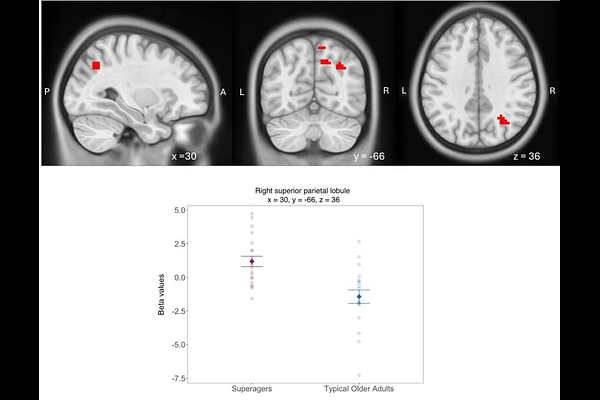
AbstractMemory performance typically declines with age, but the underlying neurobiological mechanisms remain unclear. Superagers, people over 80 years of age with episodic memory performance comparable to individuals 30 years younger, appear to resist this decline. Novelty and expectation violations are known to engage the hippocampus-midbrain system to enhance memory formation. Here, we examined whether superagers' superior memory performance is supported by preserved hippocampal-midbrain function during novelty and expectation processing. We manipulated item and contextual novelty (i.e., expectation violations) during encoding to test whether superagers show greater mnemonic benefits than their age-matched peers, whether these benefits reflect enhanced hippocampal and midbrain functioning as measured by fMRI, and whether they are associated with preserved dopaminergic integrity measured with neuromelanin-sensitive MRI. Our results show that, although superagers demonstrated overall superior memory performance, both groups exhibited superior recognition of contextually unexpected items. Nevertheless, differences emerged in the processing of expectation during encoding. Superagers exhibited stronger hippocampal responses to expectation violations and habituation to expected events, irrespective of item novelty. Conversely, typical older adults exhibited reduced midbrain response when expected novelty was absent. Neuromelanin accumulation did not account for group differences in midbrain activity or memory performance. Taken together, these findings suggest superagers benefit from adaptive responses to expectation and its violation, which is therefore a candidate mechanism distinguishing exceptional from typical cognitive ageing.