The mechanism of biofilm degradation by a detachable tailspike of gene transfer agents

The mechanism of biofilm degradation by a detachable tailspike of gene transfer agents
Bardy, P.; Nguyen, P. M.; Liu, Y.; Craske, M. W.; Read, N.; Davies, R. M.; Turkenburg, J. P.; Hart, S. J.; Antson, A. A.; Fogg, P. C. M.
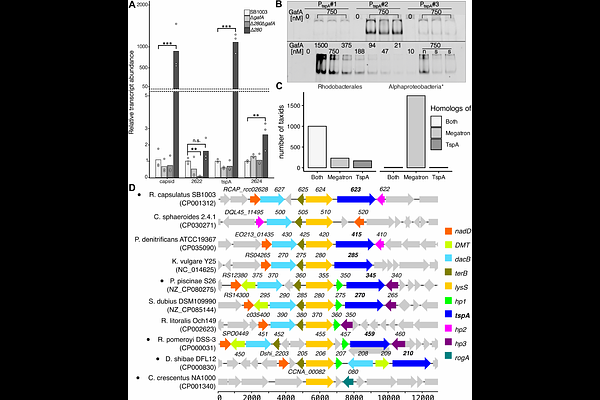
AbstractGene transfer agents (GTAs) are phage-derived elements that have evolved repeatedly across diverse prokaryotes, where they drive high-frequency horizontal gene transfer (HGT). Here, we demonstrate that the Rhodobacter capsulatus GTA (RcGTA) tailspike protein, TspA, is a potent biofilm-degrading enzyme. Purified TspA is effective at both preventing initial biofilm formation and clearing established, mature biofilms. Crucially, TspA enhances RcGTA-mediated gene transfer, suggesting that this enzyme facilitates GTA navigation through the extracellular matrix. Unlike the permanently anchored tailspikes of canonical phages, TspA possesses a unique {beta}-sandwich N-terminal domain that enables its dissociation from mature particles and engages in biofilm polysaccharide recognition. Our findings indicate that TspA is an evolutionary adaptation used by GTAs to optimize HGT within complex, densely packed microbial biofilm communities.