Sulcal pleating captures functional boundaries in human visual cortex

Sulcal pleating captures functional boundaries in human visual cortex
Williams, A.; Hoyos, P. M.; Musa, R.; Gomez, J.
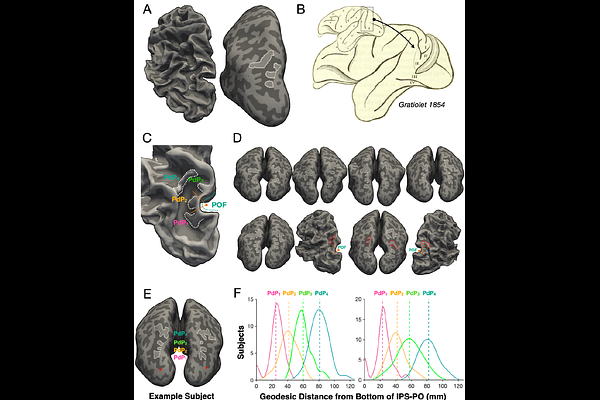
AbstractThe folding of the cortical sheet within the human brain is related to its functional organization at the level of major sulci and gyri. Yet how smaller folding features hidden within the two thirds of cortex buried in sulci may relate to functional specialization of the cortex is not clear. Using human visual cortex as a test bed, we identify four hidden brain folds within the major sulcus which spans the dorsal visual stream and demonstrate that their spatial consistency across individuals is related to functional boundaries of visual cortex. In separate observation and replication participant groups, we combine structural and functional magnetic resonance imaging to show that the boundaries separating the visual field maps comprising the dorsal stream can be predicted from these hidden gyri with an accuracy matching current probabilistic definitions of visual cortex. By further demonstrating that these hidden gyri colocalize with cytoarchitectonic regions of the human brain, and that the variability in their shape and size correlates with individual differences in visual behaviors known to rely on the dorsal stream, we provide evidence for a novel neuroanatomic framework which suggests that mesoscale pleating patterns of the cortex within human sulci are functionally and behaviorally relevant.