Palmitoylation calibrates mitochondrial transport of insulin across the endothelium in insulin resistance

Palmitoylation calibrates mitochondrial transport of insulin across the endothelium in insulin resistance
Zhang, W.; Adak, S.; Zhang, Q.; Maimaituxun, G.; Xu, R.; Dong, G.; Debnath, A.; Wang, Y.; Singamaneni, S.; Wei, X.; Semenkovich, C. F.
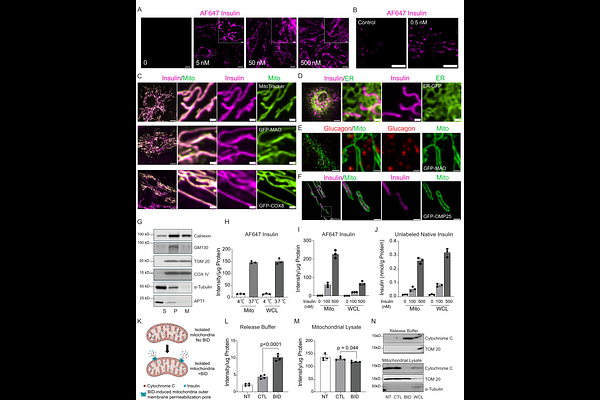
AbstractImpaired insulin transport across the endothelium contributes to insulin resistance, a poorly understood condition implicated in diabetes and many other chronic diseases. Insulin has been reported to undergo non-receptor-mediated endocytosis resembling fluid-phase uptake through unclear mechanisms. Here we show in mice with diet-induced insulin resistance that endothelial-specific deletion of the depalmitoylase acyl-protein thioesterase 1 (APT1) improved glucose tolerance and insulin sensitivity without affecting chronic inflammation or capillary structure. Endothelial APT1 deficiency increased interstitial insulin levels in mice confirmed by in-situ microneedle-based sampling. In cultured human microvascular cells, APT1 inhibition enhanced cell transport of high-dose insulin independent of the insulin receptor and canonical endocytic machinery. Unexpectedly, live-cell imaging revealed insulin rapidly localizing to mitochondria prior to endolysosomal trafficking, even at physiological insulin concentrations. APT1 inhibition delayed mitochondrial discharge of insulin to lysosomes. Cyclosporin A, an immunosuppressant known to affect mitochondrial function, preserved mitochondrial insulin content and promoted insulin transport in cultured cells, and enhanced interstitial insulin delivery in mice. Proteomic analysis revealed two palmitoylated proteins, PACS1 and YTHDF2, required for APT1-mediated mitochondrial-endolysosomal trafficking of insulin. A mitochondrial insulin shuttle in endothelial cells may participate in the physiological adaptation to hyperinsulinemia and its regulation by palmitoylation suggests a novel approach to insulin resistance.