Group size and activity influence shoal choice in Goldfish: Replication of zebrafish findings using a drift-diffusion model

Group size and activity influence shoal choice in Goldfish: Replication of zebrafish findings using a drift-diffusion model
Cheng, Z.; Ye, J.; Yan, H.; Fu, H.; Wang, M.; Zhang, X.; Yuan, M.
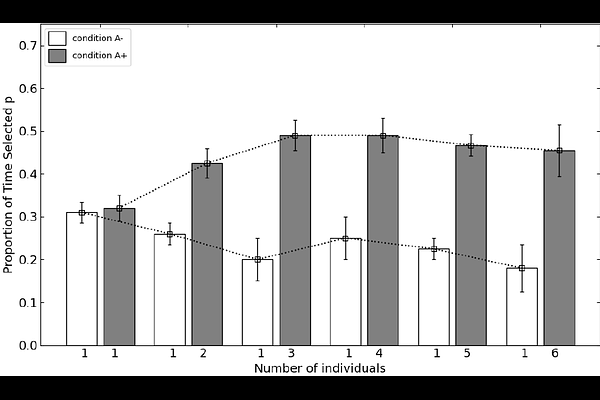
AbstractAnimals often rely on social information when making movement decisions. In zebrafish, classic work showed that shoal size and shoal activity both bias shoal choice. Here we extend these effects in Goldfish (Carassius auratus) and extend them with a drift-diffusion model (DDM) account of individual evidence accumulation under dynamic social cues. Using a three-chamber linear arena, we quantified a focal fish's position for 10 minutes while manipulating (i) numerical differences between flanking shoals and (ii) their activity (swimming speed) via temperature manipulation. ANOVA on time-proportion choices confirmed robust attraction to larger shoals; when shoal sizes were equal, the more active shoal was preferred. In combined manipulations, activity effects dominated at small numbers but saturated as group size increased, indicating a threshold-like integration where activity dominates at small shoal sizes less than 3 fish but saturates at larger sizes. We formalize these processes with a bounded DDM in which a sigmoidal stimulus function maps shoal size and average speed to momentary evidence, subject to random perturbations. The model reproduces the observed psychometric relations between relative numerosity, velocity differences, and choice. Our results generalize zebrafish findings to a carp species with distinct ecology and physiology, and provide a compact mechanistic link between social cues and individual decision trajectories in dynamic social contexts.