Hippocampal theta distinguishes between memory-guided and exploratory saccades in humans

Hippocampal theta distinguishes between memory-guided and exploratory saccades in humans
Castelblanco Riveros, C. A.; Angeli, P. A.; van der Meer, M. A.; Bujarski, K.; Robertson, C. E.
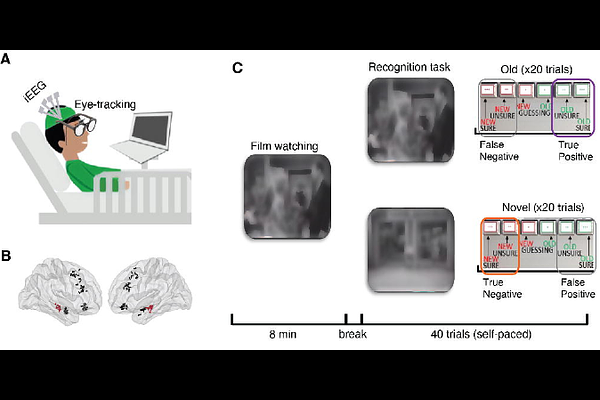
AbstractMemory shapes how we explore the visual world, but the neural mechanisms linking mnemonic processes to eye movements during naturalistic viewing are not well understood. Theta-band oscillatory activity in the hippocampus is time-locked with eye movements in primates, suggesting a putative mechanism for coordinating mnemonic processing and oculomotor behaviour. Yet, it remains unknown whether this coupling generalises to episodic memory-guided viewing in humans, whether slow (3 to 6 Hz) and fast (6 to 10 Hz) theta bands play dissociable functions, and whether this coupling is sensitive to the direction of upcoming eye movements. Here, we used intracranial EEG and eye-tracking data from 11 neurosurgical patients of either sex (Keles et al., 2024) to address these questions. Using fixation-locked analyses, we found that hippocampal theta dynamics differentiate memory-guided from memory-independent fixations of episodically encoded naturalistic scenes (i.e., movies) through power and coherence mechanisms that are both temporally and spectrally dissociable. First, immediately after fixations (~0 to 250 ms), slow-theta power was more strongly suppressed during memory-guided trials (i.e., true positive, TP) than correct memory-independent trials (i.e., true negative, TN). Second, in the period around fixations (-80 to 60 ms), theta phase coherence increased independent of power during TP vs TN trials. This increase in coherence was most pronounced for contraversive relative to ipsiversive fixations, consistent with direction-sensitive hippocampal oculomotor coordination during memory-guided viewing. Together, these findings suggest that hippocampal theta plays dissociable, time-locked roles in memory-guided fixations during naturalistic visual retrieval, supporting an ecologically relevant role for the hippocampus in coordinating memory and active visual behaviour.