A Neurofeedback therapy of facial expression recognition in Autism shifts connectivity to higher levels within the third visual pathway in relation to clinical improvements

A Neurofeedback therapy of facial expression recognition in Autism shifts connectivity to higher levels within the third visual pathway in relation to clinical improvements
Direito, B.; Sayal, A.; Mouga, S.; Castelo-Branco, M.
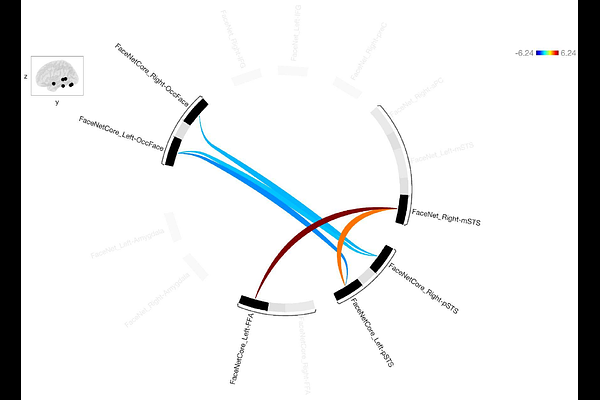
AbstractThe mechanistic role of the third visual pathway in autism spectrum disorder (ASD) remains unknown. We previously developed a neurofeedback therapy for autism targeting the posterior superior temporal sulcus (pSTS), a region in this network that underlies the perception and imagery of emotional facial expressions, resulting in improvements in adaptive behavior and recognition of fear in facial expressions. Here, we investigated the impact of this 5-session therapy on the functional connectivity of that core region of the third visual pathway. We found evidence for a profound reorganization of this network with treatment-induced decreases in connectivity between low-level visual areas, the pSTS, and the posterior occipital face area (OFA), and increased connectivity with higher-level visual regions (fusiform face area - FFA), right middle STS (mSTS), and parietal cortex. These changes, suggesting the restoration of connectivity in regions known to be underconnected in ASD, such as mSTS and pSTS, and in a set of regions belonging to the temporoparietal junction and the ventral attention network, which are known to be involved in broader aspects of social cognition, were positively associated with clinical improvements. The demonstration of treatment response associated with network reconfiguration paves the way for multicentric trials to probe this observed reorganization as a treatment target.