Age dependent collective trafficking of tissue resident T cells in zebrafish

Age dependent collective trafficking of tissue resident T cells in zebrafish
Azubuike, U. F.; Gordon, P. B.; Ly, K. L.; So, W. Y.; Le, L.; Bishop, K.; Sood, R.; Kruhlak, M.; Gottesman, M. M.; Tanner, K.
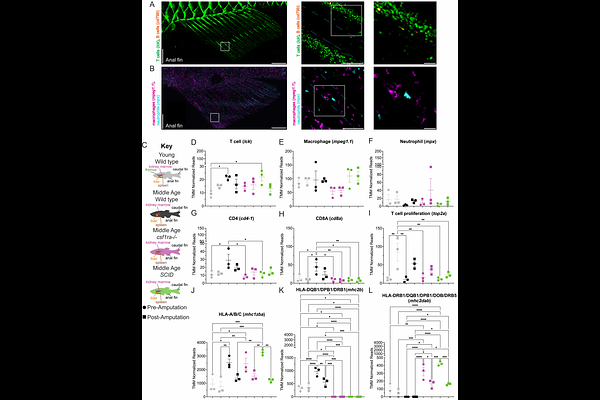
AbstractHow tissue-resident T cells are organized to provide immune surveillance in healthy peripheral tissues and how this organization changes with age remains largely unknown. Here we use intravital imaging in zebrafish to identify a previously undescribed, appendage-specific mode of adaptive immune organization: fin-resident T cells undergo coordinated collective streaming migration within connective tissue compartments. T cells colonize the developing fin prior to lymphatic or blood vessel formation, indicating that initial residency can be established independently of classical immune conduits. However, collective streaming is not immediate; it emerges during juvenile maturation, coincident with maturation of fin architecture, and is restricted to T cells rather than other leukocyte populations. After fin amputation, young adults restore streaming within regenerated tissue once spatial compartments are re-established, whereas middle-aged fish following thymic involution repopulate the fin yet fail to promptly recover coordinated streaming and show broader tissue dispersion and altered motility in comparable times. Transcriptomic profiling across ages, regenerative states, and immune-altered microenvironments reveals coupled regulation of stromal remodeling programs and antigen presentation pathways, including differential expression of MHC class I and II components with strong microenvironmental dependence. These data define an age-regulated, tissue-instructed program that organizes resident T cell dynamics and immune potential in situ, providing a framework for understanding how tissue specific stromal environments constrain immune surveillance.