Aldehyde-based cryopreservation of whole brains

Aldehyde-based cryopreservation of whole brains
Garrood, M.; Keberle, A.; Slaughter, A.; Sowa, A.; Thorn, E. L.; De Sanctis, C.; Farrell, K.; Crary, J. F.; McKenzie, A.
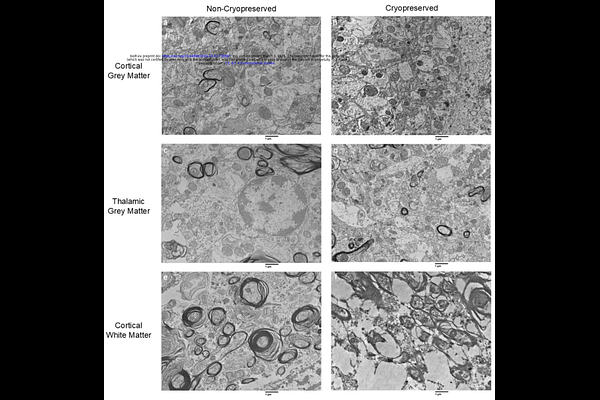
AbstractLong-term storage of aldehyde-fixed brain tissue is commonly performed in the fluid state. This has the potential to maintain morphology for many decades, but has been found to cause progressive loss of antigenicity over time for some biomolecules. While cryoprotection and subzero storage has been successfully used for brain tissue sections or blocks, methods for preserving whole brains using this approach have not been widely characterized. Here we present a protocol for the preservation of fixed whole brains using graded immersion cryoprotection and subzero temperature storage, which is one type of a more general approach that we refer to as aldehyde-based cryopreservation (ABC). Our method uses a gradual ramp-up of the osmotic concentration of cryoprotectants, leading to a final solution containing 50% (v/v) ethylene glycol and 30% (w/v) sucrose. We used CT imaging to track cryoprotectant penetration, finding that with the use of our protocol, approximately 10 months is required to reach equilibration throughout whole human brains. In our initial histological validation, we found that insufficient equilibration time prior to freezing led to apparent ice crystal artifacts seen on ultrastructural imaging of the white matter. After refining the protocol to allow adequate diffusion time, histologic data at both the light and electron microscopic levels showed preserved cellular architecture and ultrastructure after the process of cryoprotectant loading, freezer storage, and unloading. This protocol can be implemented using laboratory freezers or freezer rooms and provides a degree of resilience against freezer failures because the morphology of the fixed tissue is expected to remain preserved long-term in the fluid state even if rewarmed. Our approach may be valuable for laboratories seeking to enhance the long-term preservation of antigenicity in large brain tissue specimens for future research applications.