Nocturnal pollination services as an ecological safety net for papaya production in a tropical biodiversity hotspot

Nocturnal pollination services as an ecological safety net for papaya production in a tropical biodiversity hotspot
Otieno, M.; Peters, M. K.; Plesser, S. M.; Zhang, J.; Steffan-Dewenter, I.
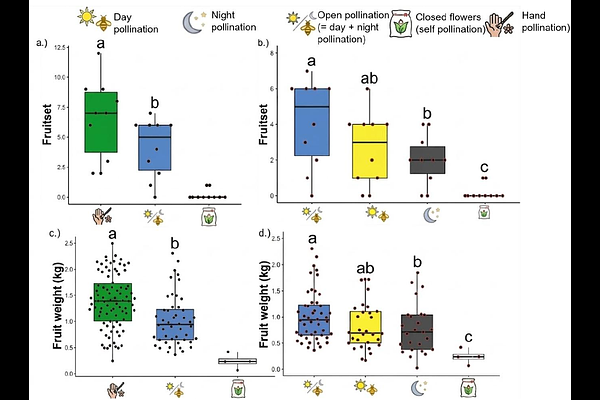
AbstractPollination is of key importance for tropical agriculture, yet a bee-centred perspective often overlooks the critical role of nocturnal insects in pollination services. We evaluated the relative contributions of diurnal and nocturnal pollinators to papaya yields on subsistence farms in the Taita Hills, Kenya, a globally important biodiversity hotspot. We combined flower visitor observations with five experimental treatments: open pollination, wind-only (closed), hand pollination, and temporal exclusions for day-only and night-only services. Our results reveal complete temporal niche partitioning between diurnal bees and nocturnal hawkmoths (Sphingidae). We found that diurnal and nocturnal pollinators provide additive, rather than redundant, services, contributing to papaya fruit set and weight to a similar extent. Despite these contributions, supplementary hand-pollination experiments indicated a significant yield gap (36.9% lower fruit set), suggesting substantial pollinator limitation. While landscape-scale factors had no significant effects, nocturnal pollinators responded positively to organic management, whereas diurnal visitors did not. This indicates that local habitat quality and ecological intensification are more critical for sustaining specialised pollinators than landscape composition. Our study highlights the vital role of nocturnal insects as an ecological safety net and emphasises that their conservation through local organic practices is essential for securing yield quantity and quality in tropical papaya farming systems.