Engineering Oncolytic Measles Virus with MG53 Couples Pyroptotic Tumor Killing with Immune Microenvironment Remodeling to Enhance Checkpoint Immunotherapy in Non-small Cell Lung Cancer

Engineering Oncolytic Measles Virus with MG53 Couples Pyroptotic Tumor Killing with Immune Microenvironment Remodeling to Enhance Checkpoint Immunotherapy in Non-small Cell Lung Cancer
Li, Z.; Hsu, C. C.; Jiang, F.; Bu, M.; Lubaba, U.; Li, S. L.; Zhao, S. L.; Lin, P.-H.; Piegols, H.; Liu, X.; Li, J.; Li, H.
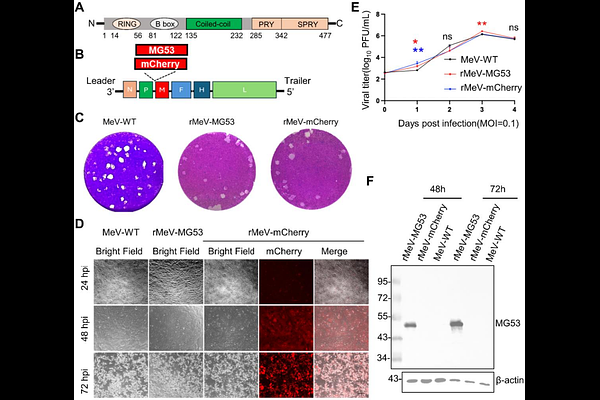
AbstractLung cancer is the leading cause of cancer-related mortality worldwide, with only approximately 30% of patients benefiting from current immune checkpoint immunotherapy. Oncolytic virotherapy offers a promising strategy to overcome this resistance; however, achieving both potent tumor cytotoxicity and robust antitumor immune activation remains a major challenge. Here, we engineered oncolytic measles virus expressing the tumor suppressor MG53 (TRIM72), designated rMeV-MG53, and evaluated its therapeutic potential against non-small cell lung cancer (NSCLC). rMeV-MG53 retained replication kinetics comparable to parental MeV while driving significantly greater cytotoxicity than an unarmed control in NSCLC cells. Mechanistically, MG53 arming amplified caspase-3-dependent apoptosis and potentiated Gasdermin E (GSDME) cleavage, engaging GSDME-mediated pyroptosis as a key tumor-killing mechanism; pharmacological inhibition confirmed caspase-dependent apoptosis as the initiating event leading to pyroptosis, while excluding necroptosis and ferroptosis as significant contributors to rMeV-MG53-induced cytotoxicity. MG53 overexpression induced an intrinsic pro-inflammatory transcriptional signature enriched for TNF, NF-{kappa}B, and IL-17 signaling, and rMeV-MG53 elicited significantly stronger type I interferon and pro-inflammatory cytokine induction than the unarmed control. In an immunocompetent, MeV-permissive syngeneic NSCLC model, intratumoral rMeV-MG53 achieved superior tumor growth inhibition, amplified caspase-3/GSDME pyroptosis, selectively up-regulated Cxcl10, Ifng, and Il1b, and drove robust CD8+ T-cell and Granzyme B+ effector infiltration. This immune remodeling was accompanied by compensatory PD-L1 upregulation, and combining rMeV-MG53 with anti-PD-L1 blockade achieved the strongest tumor suppression of all treatment groups. These findings establish MG53-armed oncolytic MeV as a strategy coupling GSDME-mediated pyroptosis with antitumor immune remodeling to sensitize immune-resistant NSCLC to checkpoint immunotherapy.