Sex Differences in Physiological Hair Cycling and Adhesive Material-Induced Hair Regeneration in Mice

Sex Differences in Physiological Hair Cycling and Adhesive Material-Induced Hair Regeneration in Mice
Chou, Y. Y.; Inoue, M.; Toge, T.; Yoshimura, A.; Takeuchi, S. Y.; Takahashi, O.; Haraguchi, K.; Kawasaki, K.; Kaminuma, O.; Matsubara, T.; Habu, M.; Kokabu, S.
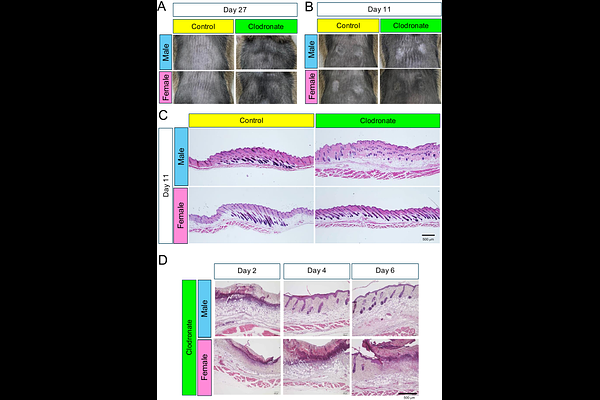
AbstractSex differences in hair growth are clinically evident, but sex-dependent regulation of physiological hair cycling and injury-induced hair regeneration remains incompletely understood. We compared physiological dorsal hair-cycle progression and adhesive material-induced localized hair regeneration in male and female C3H/He mice. Males entered the second and third anagen phases earlier than females, indicating longer telogen phases in females. In contrast, localized hair regrowth after application and removal of a cyanoacrylate adhesive material appeared earlier in females. Ovariectomy induced widespread telogen-to-anagen transition and therefore did not permit isolation of ovarian-hormone effects on the localized response. RNA sequencing of intact dorsal skin identified sex-dependent baseline expression profiles involving inflammation, wound response, and tissue repair. Independent time-course quantitative PCR further demonstrated sex-dependent expression of inflammatory and reparative genes after adhesive material application. Local clodronate liposome administration alone induced delayed perifocal hair growth. When combined with adhesive material application, clodronate treatment markedly delayed wound healing and localized hair regrowth in males, whereas these responses were comparatively preserved in females. These findings show that physiological hair cycling and adhesive material-induced hair regeneration exhibit distinct sex differences and suggest that the localized regenerative response is more macrophage-dependent in males than in females.