Fungal microbial enrichment method enables fungal metagenomics directly from human clinical samples

Fungal microbial enrichment method enables fungal metagenomics directly from human clinical samples
Porter, M. K.; Akana, R. T.; Romano, A. E.; Pei, X.; Kamel, B.; Haridas, S. F.; LaButti, K.; Grigoriev, I. V.; Wu-Woods, N. J.; Garner, O.; Underhill, D.; Ismagilov, R. F.
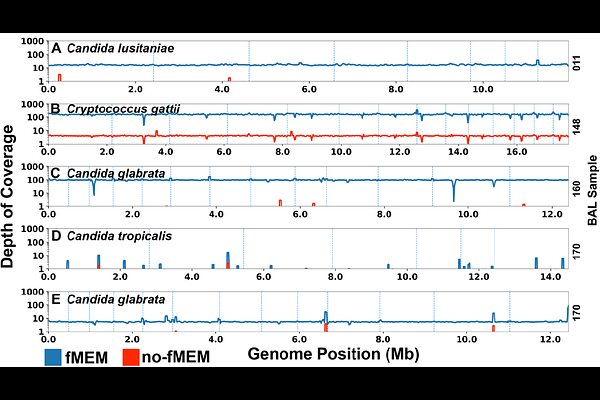
AbstractFungi play important roles in health and disease, but current methods such as culture, PCR, and amplicon sequencing cannot provide genome-level characterization directly from clinical samples. Although metagenomic sequencing could overcome these limitations, it remains impractical in clinical samples where fungal DNA is present at low abundance relative to human DNA. Here, we extend a recently described microbial enrichment method (MEM) to fungi (fungal Microbial Enrichment Method; fMEM) and test the method in bronchoalveolar lavage (BAL) samples to demonstrate direct-from-sample fungal metagenomic analysis and metagenome-assembled genome (MAG) recovery. In BAL samples, fMEM depleted human DNA by more than 1000-fold while preserving fungal DNA within 10-fold, enabling shotgun sequencing from samples with fungal biomass as low as 10 picograms fungal DNA per 200 microliters BAL. fMEM enabled de novo recovery of fungal MAGs from three of four sequenced BAL samples, including two near-complete MAGs (>90% BUSCO completeness) and one 82.1% complete MAG, with low BUSCO-estimated contamination ([≤]1.5%). Fungal MAGs recovered by fMEM also resolved potentially clinically-relevant genes, not fully predictable from taxonomy alone and revealed genomic content absent from currently-available same-species reference genomes. fMEM is compatible with a whole-genome amplification (including long-read sequencing workflows). Long reads from fMEM-processed samples provided high coverage (>10X) over fungal assemblies. fMEM compatibility with long-read sequencing enables recovery of genes that would be difficult to assemble with short reads alone. fMEM may enable new insights into the role of human-associated fungi, impacting public health, clinical management, and research into complex diseases with suspected fungal roles.