Use treadmills with caution: Walking Energy Expenditure and Metabolic Cost are elevated compared to overground across multiple speeds in healthy young adults

Use treadmills with caution: Walking Energy Expenditure and Metabolic Cost are elevated compared to overground across multiple speeds in healthy young adults
DAS GUPTA, S.; KAMISHITA, K.; KONDO, M.; KOBAYASHI, Y.
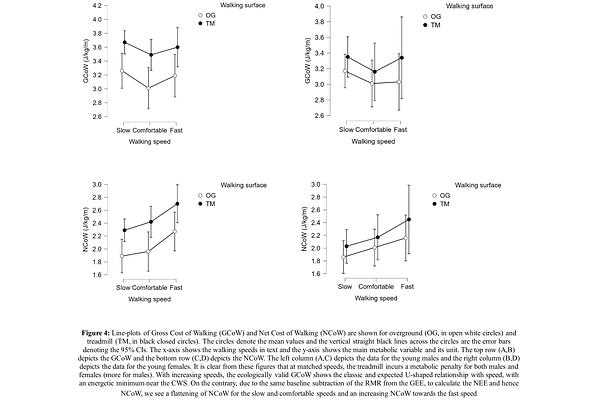
AbstractBackground: Treadmill walking is often employed for tightly controlled gait and energetics research, but growing evidence suggests that treadmill-based metabolic and biomechanical measurements may not directly reflect the ecologically valid mode of overground walking. While many previous studies focused on older adults, much less is known about how treadmill walking influences gait energetics and spatiotemporal parameters in young healthy adults across matched speeds. Aims and Objectives: We investigated energy expenditure, metabolic cost of walking and spatiotemporal gait parameters in healthy young adults walking overground and on a treadmill at three speeds (slow-1.0, comfortable-1.3, fast-1.5 m/s). Our hypothesis was that at the comfortable speed, treadmill and overground energetics and gait parameters would be comparable. However, at slow and fast speeds, there would be a significant energetic penalty, accompanied by significant differences in spatiotemporal parameters. Methods: Twenty young participants (10 males and 10 females) completed a randomized cross-over walking protocol with a minimum of ten minutes treadmill familiarization at 1.3 m/s. Breath-by-breath oxygen consumption (V O_2) and Respiratory Exchange Ratio were measured using a portable indirect calorimetry system and gait parameters were calculated from Inertial Measurement Units. Gross and net energy expenditures, costs of walking, cadence, average step and stride lengths were calculated. A three-way mixed ANOVA was used for primary statistical analyses. Results: Treadmill walking was characterized by higher gross and net energy expenditures and metabolic costs (p<0.001, p2 = 0.6) across all speeds compared to overground. It was also characterized by faster cadence and shorter average step and stride lengths (p<0.001, p2 = 0.9). Additionally, there was an effect of sex (p = 0.01, p2 = 0.3) on the gait parameters, with females exhibiting a faster cadence and shorter average step and stride lengths than males. Discussion and Conclusions: Our findings show that treadmill walking imposes a medium-to-large metabolic penalty even in healthy young adults, with compensatory gait adaptations, possibly reflecting increased stabilization demands and altered neuromuscular control strategies. These results underscore the limits of generalizing treadmill derived gait data to overground walking and we caution against the uncritical use of treadmills, especially while trying to understand ecologically relevant human walking mechanics and energetics. Keywords: Metabolic cost, Treadmill walking, Overground walking, Gait energetics, Inertial measurement units, Sex differences