Parental care enhances reproductive success without remodeling the carcass microbiome in a wild burying beetle

Parental care enhances reproductive success without remodeling the carcass microbiome in a wild burying beetle
Lin, W.-J.; Hsieh, C.-H.; Sun, S.-J.
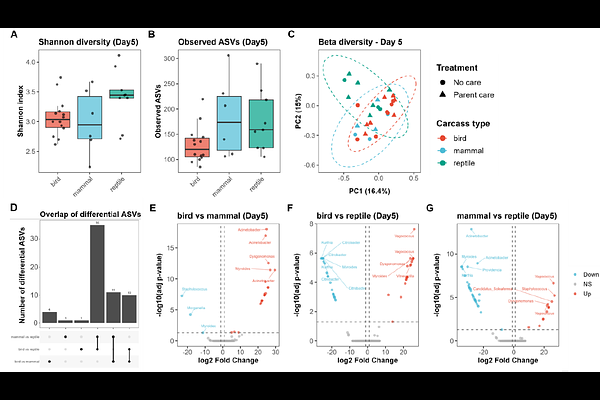
AbstractNutrient cycling depends on interactions between insect decomposers and the microbial communities that colonize ephemeral resources such as animal carcasses. Burying beetles (Nicrophorus spp.) are thought to manipulate carcass microbiomes to facilitate reproduction, yet most experimental work relies on a few standardized laboratory carcasses that obscure the ecological heterogeneity beetles face in the wild. Using 76 carcasses from 27 vertebrate species of birds, mammals, and reptiles, we manipulated Nicrophorus nepalensis parental care and characterized carcass, adult-gut, and larval-gut microbiomes by 16S rRNA sequencing. Parental care strongly increased breeding success and brood mass, and buffered reproductive success against variation in carcass identity. By contrast, carcass type and decomposition stage, not care, primarily structured the carcass microbiome; a modest care signature emerged only late in decomposition, was strongest in the adult gut, and was absent from the larval gut. Parental care thus acts principally as a direct driver of reproductive success rather than by remodeling the carcass or larval microbiomes.