Spatial genotypic patterns within monospecific stands of a dominant coral revealed through photogrammetry-guided sampling.

Spatial genotypic patterns within monospecific stands of a dominant coral revealed through photogrammetry-guided sampling.
van Hulten, D.; Liggins, L.; Yuval, M.; Sewell, M. A.; Bongaerts, P.
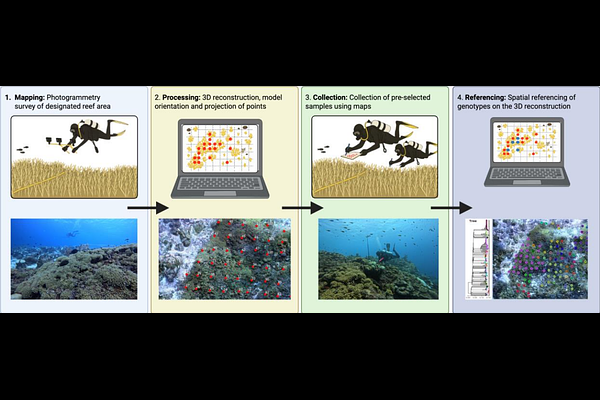
AbstractLocal and global stressors are driving declines in competitive reef-building corals and favouring stress-tolerant, weedy species. In many of these taxa, rapid asexual reproductive strategies promote the proliferation of existing genotypes at small spatial scales, potentially leading to the formation of monospecific stands ("carpets"). Such reproductive strategies raise concerns for the intraspecific diversity and resilience of future reefs. The genetic structure of these spatially dominant, weedy corals remains poorly understood, in part because densely aggregated colonies lack distinct boundaries, hindering the use of standard sampling designs. We employed a photogrammetry-guided, spatially explicit sampling approach to assess the genotypic diversity and genet distribution in the increasingly dominant scleractinian coral Madracis auretenra across three reef sites in Curacao. Cover of M. auretenra varied widely among sites and reef zones (4.1-26.2%). Genome-wide genotyping of 678 samples collected at 1-m intervals identified two genetically distinct lineages comprising 90% and 10% of the samples, with contrasting genotypic diversity (genet-to-ramet ratio Ng/N = 0.287 and 0.481, respectively). Monospecific stands (n = 20) usually contained multiple genotypes and occasionally even both lineages, but were typically dominated by a single genotype (mean 65.5%, minimum 42.3%). Simulated sampling demonstrated that combining monostands, patches, and isolated colonies would maximise captured genotypic diversity for restoration applications. Our results demonstrate that photogrammetry-guided sampling provides an effective, unbiased framework for population genetic studies of monostand-forming corals while revealing substantial genotypic diversity within a species that is becoming increasingly dominant on southern Caribbean reefs.