Assessing the Role of Marker Density and Minor Allele Frequency on Machine Learning Driven Genomic Selection Accuracy in Grapevine

Assessing the Role of Marker Density and Minor Allele Frequency on Machine Learning Driven Genomic Selection Accuracy in Grapevine
Francisco, F. R.; de Oliveira, G. L.; Niederauer, G. F.; Fritsche-Neto, R.; Souza, A. P. d.; Furlan, M. F. M.
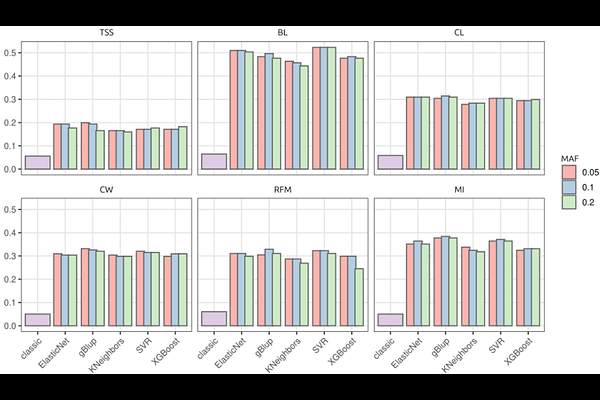
AbstractAlthough grapevine (Vitis spp.) is among the oldest and most economically significant fruit species globally, its genetic improvement faces major bottlenecks due to long juvenile periods and extended cycles for phenotypic evaluation. In this context, genomic selection (GS) has emerged as an effective alternative to traditional selection, offering a robust framework to optimize breeding programs by significantly reducing generation intervals while enhancing predictive accuracy (PA) in early generations and expected genetic gains (EGGs). Nevertheless, factors such as minor allele frequency (MAF) and population size can significantly affect predictive models, even to the point of making their use unfeasible in breeding programs. In this context, this study evaluated the effect of data dimensionality reduction on GS accuracy by selecting single-nucleotide polymorphisms (SNPs) based on MAF thresholds. The experimental design tested the predictive capacities of four machine learning (ML) algorithms (ElasticNet, K-Neighbors, Support Vector Machine Regression, and XGBoost) alongside the conventional Genomic Best Linear Unbiased Prediction (gBLUP) model. These were validated using three SNP datasets (11,115, 9,494, and 6,100 markers) filtered by MAF levels of 0.05, 0.1, and 0.2 across six genetic traits, and EGGs were compared between conventional breeding and GS via the breeders` equation. The results revealed that the ML models exhibited remarkable stability, with no significant differences in PA across the different MAF-based SNP densities, except for berry length, which showed a substantial difference with XGBoost at an MAF of 0.2. Conversely, gBLUP demonstrated high sensitivity to dimensionality reduction, with its performance significantly impacted by MAF filtering across all the traits. These results suggest that compared with traditional GS models that rely on a genomic kinship matrix, ML-based approaches offer greater flexibility in feature reduction. Additionally, compared with chemical traits, morphological traits generally had greater predictive ability. Furthermore, every GS model provided estimated genetic gains superior to traditional breeding, with improvements ranging from an 8.90-fold increase in berry length to a 2.86-fold increase in total soluble solids, confirming that GS integration is promising for enhancing breeding efficiency in grapevines.