Domain-specific mutations in unc-6/Netrin differentially affect dorsal-ventral axon pathfinding in Caenorhabditis elegans

Domain-specific mutations in unc-6/Netrin differentially affect dorsal-ventral axon pathfinding in Caenorhabditis elegans
Hooper, K. M.; Clark, S. G.; Lundquist, E. A.
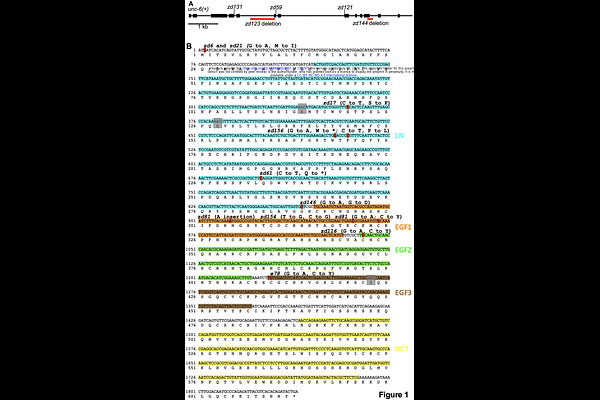
AbstractUNC-6/Netrin is a conserved regulator of dorsal-ventral axon and cell migrations. UNC-6 is composed of a Laminin N-terminal domain (LN), three epidermal growth factor repeats (EGF), and a Netrin C terminal domain (NC). Here, we identified missense mutations in distinct UNC-6 domains and assessed their roles in dorsal VD/DD motor axon guidance and ventral AVM axon guidance. A missense mutation in a conserved residue of the LN domain (G289D) resulted in dorsal and ventral axon guidance defects similar to unc-6 null. A distinct missense mutation in the LN domain (S120F) was hypomorphic and strongly perturbed ventral AVM axon guidance with minimal effects on dorsal VD/DD axon guidance, showing that S120F is predominantly required for ventral guidance. Missense mutations altering conserved cysteine residues involved in di-sulfide bonding in the EGF domains were analyzed. EGF1(C321G) caused both ventral and dorsal axon guidance defects albeit weaker than unc-6 null, indicating that EGF1 is required for both. EGF2(C347Y) strongly affected dorsal VD/DD axon guidance similar to unc-6 null, with weaker perturbation of ventral AVM axon guidance. Previous results revealed that EGF3(C410Y) specifically disrupted dorsal axon guidance, a result that we confirmed. Our studies using missense mutations in the endogenous unc-6 locus complement previous structure-function studies using transgenic expression, and identify domains specifically required for ventral AVM guidance (S120Y in the LN domain) and dorsal VD/DD axon guidance (C410Y in EGF3). The crystal structure of UNC-6 indicates conserved N-linked glycosylation at N114 and N128. Mutation of these sites in UNC-6 had no effect on dorsal ventral axon guidance, showing that they do not play a major role. However, the N114 and N128 mutations interacted genetically with unc-40 and unc-5 mutations, indicating that these glycosylation sites indeed have a role in UNC-6 signaling. Our results will inform studies on how these distinct UNC-6 domains interact with guidance receptors (e.g. UNC-40/DCC and UNC-5) and other extracellular molecules to mediate dorsal-ventral axon guidance.