Astrocyte dysfunction distinguishes monozygotic twin C9orf72 expansion carriers discordant for amyotrophic lateral sclerosis.

Astrocyte dysfunction distinguishes monozygotic twin C9orf72 expansion carriers discordant for amyotrophic lateral sclerosis.
Shaw, A. C.; Pasniceanu, I. S.; Stevenson, R.; Moutin, C.; Erdi-Krausz, G.; Parker, M. D.; Wyles, M.; Souza, C. D. S.; Higginbottom, A.; Castelli, L.; Kirby, J.; Hautbergue, G. M.; Ferraiuolo, L.; Livesey, M. R.; Cooper-Knock, J.; Shaw, P. J.
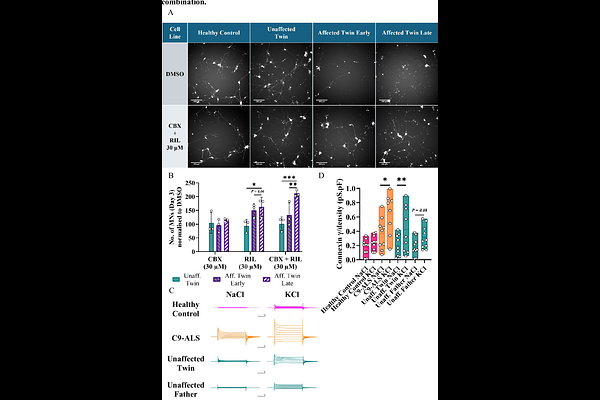
AbstractHexanucleotide repeat expansions in C9orf72 are the most common genetic cause of amyotrophic lateral sclerosis, yet many carriers remain asymptomatic for decades or never develop disease. This incomplete penetrance suggests that phenoconversion from genetic susceptibility to symptomatic disease onset is governed by epigenetic, environmental and cell-intrinsic modifiers. Astrocytes are key mediators of non-cell-autonomous neurodegeneration in ALS, but whether they undergo disease-associated phenoconversion in C9orf72 expansion carriers remains unclear. We investigated astrocyte-associated mechanisms of phenoconversion using a unique C9orf72 pedigree comprising monozygotic twins discordant for ALS and their asymptomatic father. This enabled analysis across a continuum from non-penetrance to late-stage neurodegeneration while controlling for inherited genetic background. Notably, the unaffected twin exhibited hypermethylation of the expanded C9orf72 allele, identifying an epigenetic correlate of non-penetrance. To define symptomatic and asymptomatic-associated astrocyte states, fibroblasts from this pedigree were directly reprogrammed into astrocytes and subjected to molecular, functional, electrophysiological and translatome analyses. Astrocytes derived from symptomatic ALS individuals were found to exhibit astrocyte-mediated toxicity towards motor neurons, canonical C9orf72 molecular pathology and connexin-related membrane dysfunction. Specifically, RNA foci and dipeptide repeat protein burden peaked in astrocytes obtained early in disease in the symptomatic twin and declined in astrocytes derived from samples obtained at advanced disease stages, whereas motor neuron toxicity increased progressively, demonstrating a dissociation between aggregate burden and functional neurotoxicity. In contrast, connexin-mediated electrophysiological dysfunction emerged with symptomatic disease and closely tracked with maximal toxicity. Translatome profiling revealed early global translational repression and impaired proteostasis in symptomatic astrocytes, whereas unaffected and non-penetrant C9-carriers retained enrichment of protein homeostasis pathways. These findings define distinct astrocyte states associated with asymptomatic, early symptomatic and late-stage disease. Notably, the affected twin reported substantially higher lifetime strenuous physical activity compared to the unaffected twin, consistent with a potential role for sustained exercise-related stress in accelerating disease onset in genetically susceptible individuals. Experimentally modelling increased stress induced aberrant upregulation of connexin-mediated currents in C9orf72 astrocytes, including in asymptomatic carriers, indicating that physiological stress can unmask latent astrocyte-intrinsic vulnerability and precipitate dysfunction in cellular homeostasis. Together, these findings redefine phenoconversion in C9orf72-associated amyotrophic lateral sclerosis to be associated with a significant upregulation of astrocyte toxicity, failure of resilience and demonstrate that the astrocyte disease state can be potentially induced by external stressors.