Expansion of Olfactory Receptor Family 14 Across Fossorial and Insectivorous Mammals

Expansion of Olfactory Receptor Family 14 Across Fossorial and Insectivorous Mammals
Hughes, G. M.; Ryan, L.
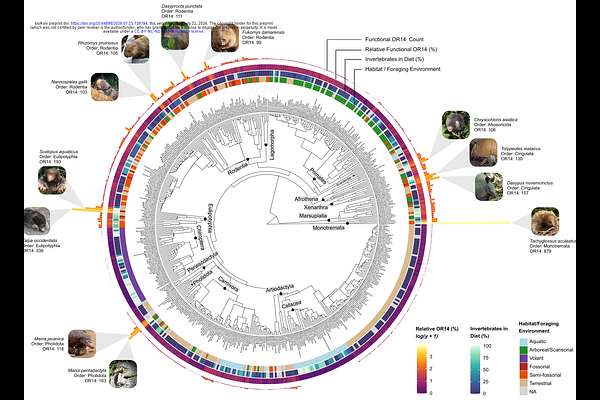
AbstractMammals have incredibly diverse olfactory repertoires, reflected in significant copy number variation of olfactory receptor genes across species. As mammals occupy a wide range of habitats and foraging environments, it is expected that such variation is shaped by ecological niche. Indeed, several studies have shown that specific olfactory receptor gene families are associated with habitat and dietary specialization. Despite this, there is currently little known about the ecological factors driving variation of olfactory receptor family 14 (OR14) across mammals. Here, we address this gap by mining mammalian genomes to identify and classify OR14 genes across hundreds of species. By mapping OR14 variation onto dietary and habitat variables, in the context of the mammalian phylogenetic tree, we identify key factors associated with OR14 evolution across mammals. Specifically, we find that OR14 has undergone repeated expansion across independent lineages of fossorial and insectivorous mammals, suggesting that expansion of this gene family may be adaptive and driven by convergent ecological pressures. By performing principal component analysis and k-means clustering based on OR14 subfamily composition, we find that species cluster irrespective of phylogeny. Furthermore, we show that many independent myrmecophagous lineages form a single cluster, providing evidence of convergence at the sequence level, potentially driven by selection for ant/termite rich diets. Together, our results indicate that OR14 plays an important functional role in fossorial and insectivorous mammals, providing a foundation for future studies aimed at deorphaning these receptors.