Epipelagic to mesopelagic variability of acoustic backscatter in the California Current

Epipelagic to mesopelagic variability of acoustic backscatter in the California Current
Guiet, J.; Wall, C.; Srinivasan, K.; Bianchi, D.
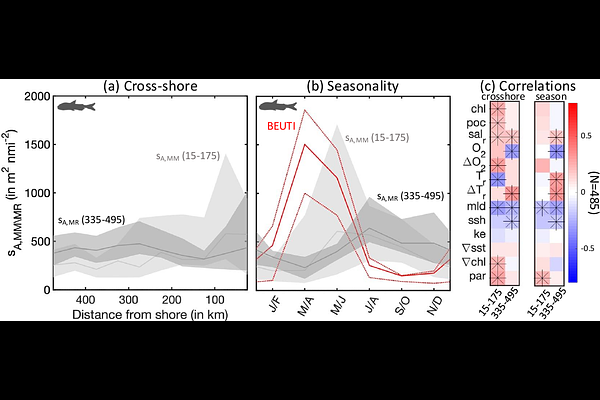
AbstractMid-Trophic Level (MTL) organisms---including krill, forage fish, and mesopelagic fish---are abundant in the California Current System (CCS) and play an essential role in transferring energy and biomass from primary producers to top predators. However, their spatiotemporal distribution and variability remain poorly understood, particularly with respect to vertical structure across epipelagic and mesopelagic habitats and coastal-offshore gradients. This lack of understanding emerges from both the complexity of MTL interactions with a heterogeneous environment and the challenges associated with sampling these organisms at high spatial and temporal resolution. To address this gap, we analyze 11 years of fisheries acoustic observations in the CCS (2006-2016) to characterize the spatiotemporal dynamics of MTLs as inferred from acoustic backscatter. Acoustic observations at 38 and 120 kHz, collected during day and night across depth strata from 15 to 495 m, reveal consistent cross-shore, seasonal, and latitudinal patterns in the backscatter of acoustically defined zooplankton, epipelagic fish, and mesopelagic fish communities. These patterns include: (1) weaker cross-shore gradients in mesopelagic relative to epipelagic communities; (2) a temporal succession among communities associated with seasonal upwelling; and (3) a multimodal latitudinal distribution with distinct coastal backscatter peaks. We further investigate relationships between acoustic backscatter and co-located environmental variables from in situ, remote sensing, and reanalysis products to elucidate plausible mechanisms underlying MTL dynamics.