The orbitofrontal cortex constructs allocentric schemas by integrating dynamic mobile agents with static environmental anchors

The orbitofrontal cortex constructs allocentric schemas by integrating dynamic mobile agents with static environmental anchors
Zhu, Z.; Zhang, B.; Zhang, X.; Naya, Y.
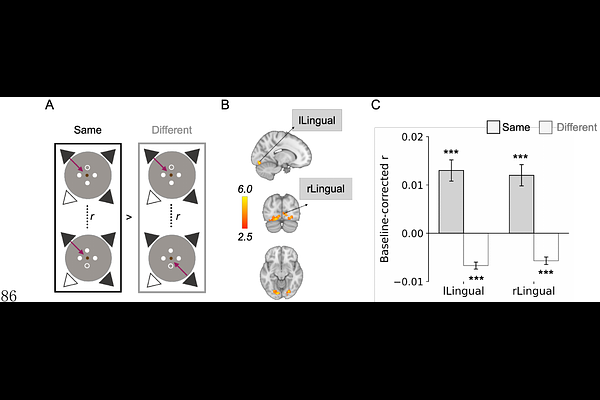
AbstractScene construction involves the automatic synthesis of fragmented visual inputs into coherent mental models. While previous work has focused on static landscapes, real-world scenes require integrating dynamic agents with stable environmental anchors. We investigated the neural hierarchy underlying this transformation using an automatic space-encoding task in a 3D virtual-reality environment and fMRI representational similarity analysis. Results revealed functional segregation across visual cortex: the superior lateral occipital cortex encoded the first-person perspective of mobile character layouts, whereas the lingual gyrus and occipital fusiform cortex represented environments specified by visible landmarks. The orbitofrontal cortex integrated these streams into an allocentric spatial schema, capturing relational geometry beyond the current visual field. Following encoding, these representations were expressed in the anterior hippocampus for self-localization. Together, the findings demonstrate an automatic hierarchical transformation in which the OFC serves as a central scaffold for constructing allocentric spatial frameworks underlying stable scene representation.