Mapping the distribution of elms in Britain after a century of Dutch elm disease

Mapping the distribution of elms in Britain after a century of Dutch elm disease
Walter, C.; Vatanparast, M.; Quintero-Berns, C.; Shreeve, D.; Webber, J. F.; Brasier, C.; Buggs, R.
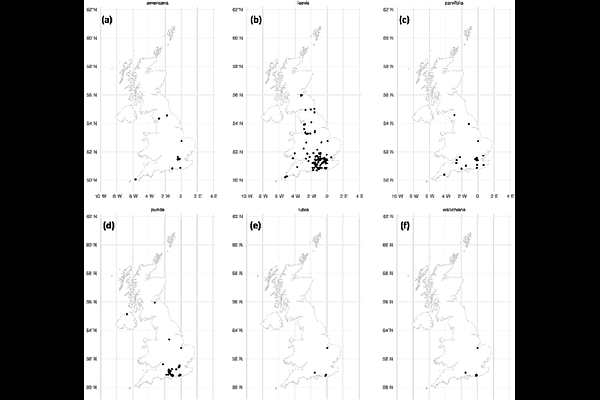
AbstractThe establishment of novel pests and pathogens that devastate populations of trees is increasing around the world, giving rise to policy and management decisions about how to restore treescapes. Such decisions may be informed by the example of Dutch elm disease (DED) which caused most mature elms in Europe and North America to be lost in the mid-20th Century. Although affected elms can regenerate, they succumb again after several years. Considerable effort has been made to restore elm through: (1) cloning and breeding of surviving local trees, (2) introduction of resistant Asiatic species, (3) introduction or production of hybrids bred from local and Asiatic species. As trees are planted out into the landscape, it is necessary to record them, and monitor their survival. Here, we compile and map 82,244 elm trees in Britain recorded as 269 distinct elm species, hybrids and cultivars. The vast majority of records are for surviving field elm, English elm and wych elm, which would grow again to maturity if the virulence of the pathogen could be attenuated. The most commonly planted elms were the hybrids: Nanguen (commercial name Lutece), followed by New Horizon, Ademuz, Lobel and Sapporo Autumn Gold, each of which had over 200 occurrences. The current elm-scape of Britain represents much restoration effort and contains considerable genetic diversity.