The overlooked role of muscle regeneration failure in post-implantation complications: a thorough investigation into mechanisms of recurrent urethral stricture

The overlooked role of muscle regeneration failure in post-implantation complications: a thorough investigation into mechanisms of recurrent urethral stricture
Fayzullin, A.; Chepelova, N.; Serejnikova, N.; Fayzullina, N.; Mustafin, M.; Bazarkin, A.; Bashkatova, M.; Drakina, O.; Antoshin, A.; Khristidis, Y.; Xue, L.; Yu, A.; Butnaru, D.; Shpot, E.; Bezrukov, E.; Chinenov, D.; Glybochko, P.; Vinarov, A.; Timashev, P.
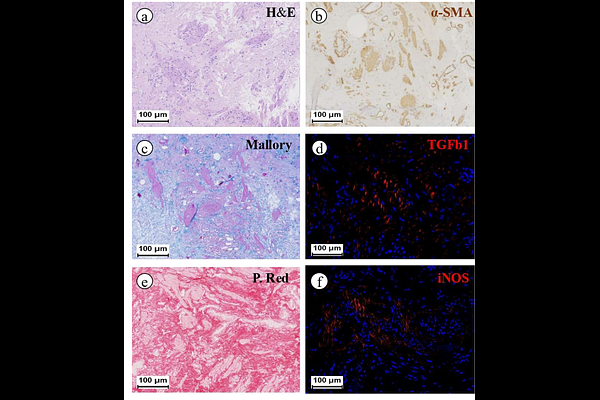
AbstractBioresorbable collagen membranes rarely achieve complete organ regeneration, often necessitating secondary operations. In this study, urethral defects were modeled in 60 Chinchilla rabbits; 30 were reconstructed using collagen membrane patches. Histological, immunohistochemical and in situ PCR analyses were performed at multiple time points up to 270 days post-implantation to assess inflammatory (TGF-{beta}1, Wnt2, iNOS) and regenerative (collagen I/III, -SMA, E-cadherin) markers. A biopsy from a patient with recurrent urethral stricture was analyzed using the same methodology. At three months after implantation, the mucosal layer had recovered, however, the underlying muscle layer remained incompletely regenerated. The muscle bundles were surrounded by -SMA-positive myofibroblast-rich connective tissue with upregulated profibrotic markers. Comparable patterns of impaired muscle regeneration and high TGF-{beta}1 expression were found in the human specimen. Our findings suggest that while muscle layer regeneration is essential for structural restoration, it may also trigger a sustained profibrotic cascade.