Memory transfer unfolds through rapid shifts in memory stability states during sleep in humans

Memory transfer unfolds through rapid shifts in memory stability states during sleep in humans
Li, X.; Uji, M.; Katsumata, R.; Suzuki, C.; Ueno, K.; Fukunaga, M.; Aritake Okada, S.; Waggoner, R. A.; Tamaki, M.
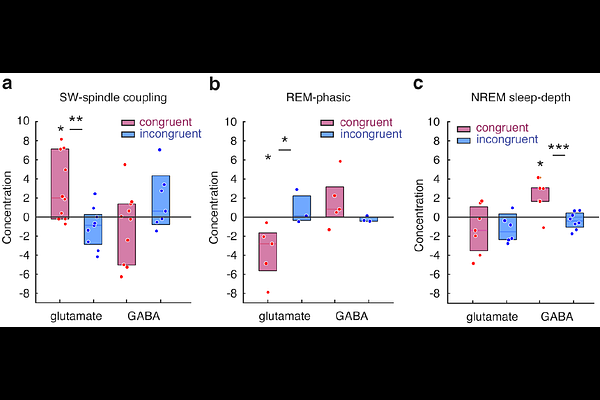
AbstractSleep benefits learning and memory. Fundamental questions remain regarding whether and how sleep transfers memories for adaptive behavior in humans. We demonstrate that declarative to procedural memory transfer occurs through rapid network reorganization and memory stability shifts in human participants. Following local processing in motor circuit during slow wave-spindle coupling in nonrapid eye movement (NREM) sleep, multiregional communication during phasic rapid-eye movement (REM) sleep enables transfer. By leveraging a newly developed time-resolved simultaneous ultrahigh-field magnetic resonance spectroscopy and polysomnography, we further reveal that memory state becomes instantaneously malleable during slow wave-spindle coupling then enters a hyperstable state during phasic-REM sleep. Thus, sleep bridges memory systems, utilizing increased instability in NREM sleep, and transferring memory through hyperstabilization in REM sleep for knowledge integration.