Ionic strength modulates structural disorder and protein oligomerization in the marginally disordered Phd transcription factor

Ionic strength modulates structural disorder and protein oligomerization in the marginally disordered Phd transcription factor
Zavrtanik, U.; Muruganandam, G.; Prolic-Kalinsek, M.; Hammerschmid, D.; Sobott, F.; Volkov, A. N.; Loris, R.; Hadzi, S.
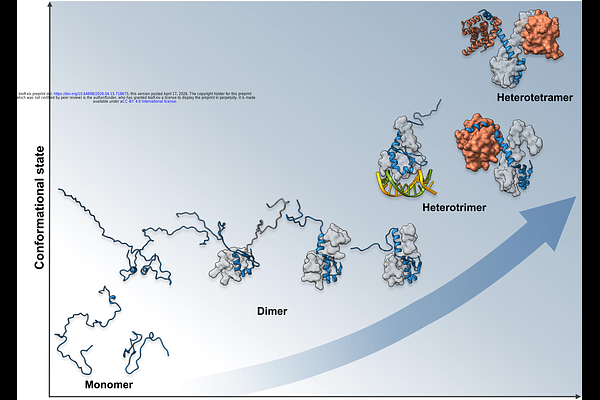
AbstractSome proteins combine sequence features that are typical both for folded proteins and intrinsically disordered proteins (IDPs). The borderline properties of these so-called "marginal" IDPs render their conformational ensembles highly sensitive to the environmental changes, which may be important for their function. Here, we investigate the prokaryotic transcription factor Phd, which regulates the phd-doc toxin-antitoxin module through an allosteric mechanism involving disorder-order transition. Using an ensemble of biophysical techniques, we show that the protein is completely disordered at low ionic strength, whereas increasing salt concentration promotes its collapse into a partially ordered monomeric state, followed by the formation of a structured dimer. Using a thermodynamic model, we decipher the linkage between ionic strength, protein stability, oligomer state and degree of disorder. Via small-angle X-ray scattering we derive the structural ensemble of dimeric Phd, revealing a gradation of disorder as a function of salt. The sequence and biophysical properties of Phd position it at the boundary between macroscopically distinct conformational ensembles, representing a large pool of states capable of engaging in functional disorder-to-order interactions, enabling Phd to act as conformational rheostat. Together with previous crystallographic data, this charts the full spectrum of disorder-to-order states in the bacterial transcription factor and underscores the structural plasticity of IDPs with the marginal sequence properties.