Circadian Timekeeping in the Tropics: Rhythmic Transcriptome and Diurnal Regulatory Networks in Rubroshorea leprosula

Circadian Timekeeping in the Tropics: Rhythmic Transcriptome and Diurnal Regulatory Networks in Rubroshorea leprosula
Singh, S. K.; Seki, M.; Ito, H.; Tani, N.; Ikezaki, Y.; Ohta, K.; Yeoh, S. H.; Ching, N. C.; Satake, A.
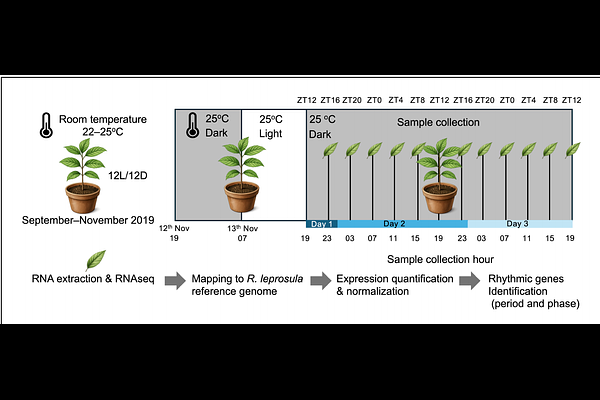
AbstractCircadian rhythms allow plants to regulate internal processes to align with daily rhythms in the environment. Comparing circadian clocks across environments is essential because latitude-dependent variation in light and temperature imposes distinct selection pressures that shape the evolution and function of circadian timing systems. However, circadian clock studies have largely focused on temperate and subtropical species, leaving transcriptional circadian networks in tropical plants under relatively constant environments poorly understood. We report the first comprehensive circadian transcriptome of the ecologically important dipterocarp species Rubroshorea leprosula, a dominant species in tropical rainforests in Southeast Asia. One sapling was sampled every four hours for 48 hours under constant darkness and used for transcriptomic analyses. Only 283 of 20,748 expressed genes (~1.3%) exhibited significant circadian oscillations, with periods strongly concentrated between 23 and 25 h. Hierarchical clustering revealed four temporal clusters with alternate phases of expression and functional specialisation; morning clusters in processes related to light and chloroplast, midday clusters in hormone and signalling mechanisms, afternoon clusters in mitochondrial and peptide biosynthesis functions, and night clusters in protein quality control and autophagy. Comparative analysis identified clear orthologs for all major Arabidopsis circadian clock components (LHY, CCA1, PRRs, TOC1, ELF4, LUX, GI, ZTL, RVEs), with conserved synteny to Parashorea chinensis, a close relative of R. leprosula. Time-lagged cross-correlation (TLCC) network reconstruction identified a characteristic circadian topological similarity with Arabidopsis, including coupled morning and evening feedback loops and paralog expansion that maintained overall structure. Peak expression timing of these core clock genes in the tropical tree was largely consistent with that observed in Arabidopsis thaliana. In contrast to this conserved phase relationship, Rubroshorea orthologs exhibited reduced amplitudes and lower coefficients of variation in their circadian oscillations, suggesting diminished robustness of rhythmic gene expression. These findings demonstrate a conserved but regulated circadian mechanism in R. leprosula, in preparation for adaptation to tropical rainforest's stable light and temperature regimes. This study lays the molecular foundation for circadian regulation in dipterocarps and offers a system for integrating rhythmic gene expression to ecological function and forest productivity in tropical communities.