Evolutionary regimes determine the accuracy of epistasis inference from temporal genetic data

Evolutionary regimes determine the accuracy of epistasis inference from temporal genetic data
Shimagaki, K. S.; Barton, J. P.
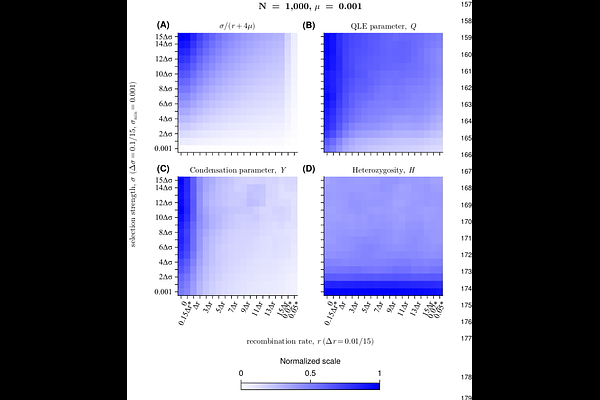
AbstractEpistasis, the non-additive effects of mutations, shapes fitness landscapes and evolutionary trajectories. Temporal genetic data reveal evolutionary dynamics and could be used to infer epistatic interactions, especially through linkage disequilibrium (LD) between interacting mutations. However, other evolutionary forces can also generate LD, challenging inference. Here, we systematically evaluated the accuracy of a variety of epistasis inference approaches across a range of selective pressures, recombination rates, and population sizes. In general, we found that inference accuracy depends on the evolutionary regime: methods based on marginal path likelihood (MPL) performed best under strong selection and low recombination, whereas quasi-linkage equilibrium (QLE) approaches were more accurate when recombination is frequent. We further showed that the strength of genetic drift can influence inference accuracy for approaches that learn from changes in allele frequencies over time. Collectively, our results show that the detectability of epistasis from temporal genetic data depends on the interplay between selection, recombination, and genetic drift, providing guidance for method selection across evolutionary contexts.