Haplotype-based insights into the genetic architecture of net blotch resistance in barley

Haplotype-based insights into the genetic architecture of net blotch resistance in barley
Liu, D.; Zhang, X.; Snyman, L.; Garrard, T.; Wallwork, H.; Dadu, H.; Maclean, M.; Tong, J.; Chen, C.; Gamaralalage, D. J.; Periyannan, S.; Hickey, L.; Hayes, B. J.; Dinglasan, E.
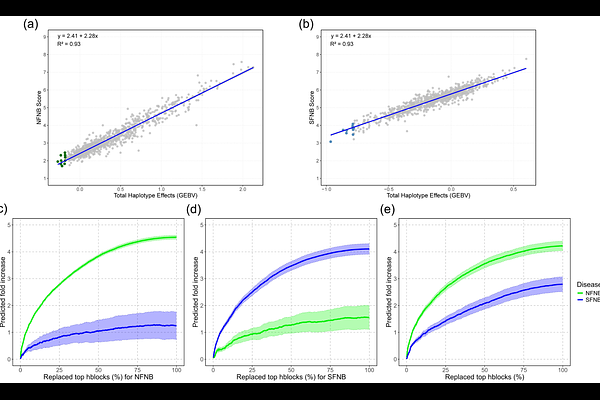
AbstractNet blotch, caused by Pyrenophora teres, is a major constraint to barley production worldwide and occurs as two epidemiologically distinct forms: net form net blotch (NFNB) and spot form net blotch (SFNB). Although numerous resistance loci have been reported in recent years, their genetic relationship remains poorly understood, and the effective deployment of resistance is constrained by the complex genetic architecture of net blotch resistance. In this study, we used a haplotype-based mapping approach to dissect the genetic basis of resistance to NFNB and SFNB in a diverse panel of 950 barley accessions from the Australian Grains Genebank (AGG). Disease responses were evaluated across 13 experiments, and a total of 40 quantitative trait loci (QTL) were identified, including 26 associated with NFNB, 29 with SFNB, and 15 common for both diseases. Most loci co-localized with previously reported QTL, while six putative novel haploblocks highlighted untapped genetic diversity within the AGG collection. Correlation analyses across phenotypic, genetic and haploblock levels revealed a partial but incomplete overlap in resistance mechanisms between NFNB and SFNB. Among the 4,497 haploblocks, approximately 60% of them showed positive local genetic correlations between the two diseases, suggesting shared genomic contributions to resistance. Haplotype composition analysis further identified a resistant haplotype group, mainly comprising accessions of Asian origin, that exhibited high levels of resistance to both forms of net blotch. Through in-silico haplotype stacking simulations, we demonstrated the cumulative genetic potential achievable by combining favourable haplotypes. When the breeding objective was to improve resistance to both NFNB and SFNB, dual-disease stacking strategies outperformed single-disease approaches, highlighting the value of prioritising haplotypes with positive pleiotropic effects. Overall, this study provides a comprehensive haplotype-level framework for understanding net blotch resistance and delivers practical insights for breeding barley cultivars with durable and broad-spectrum resistance to both NFNB and SFNB.