A Biphasic Effect of Alcohol on Endothelial Plasticity Through Regulation of Endothelial-to-Mesenchymal Transition

A Biphasic Effect of Alcohol on Endothelial Plasticity Through Regulation of Endothelial-to-Mesenchymal Transition
Liu, W.; Gusti, Y.; Athar, F.; Rajendran, N. K.; Cahill, P. A.; Redmond, E. M.
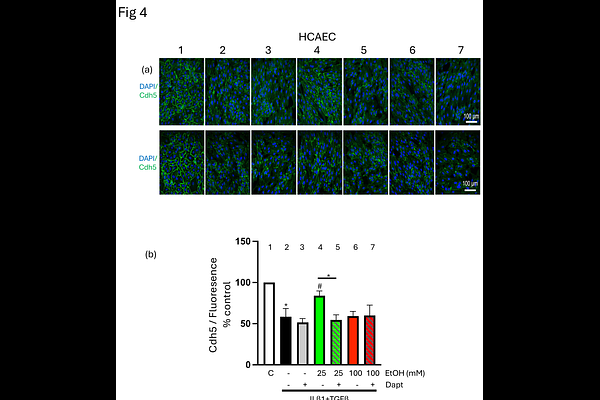
AbstractBackground. Alcohol consumption influences cardiovascular disease, but whether it does so by affecting endothelial plasticity is unknown. We tested whether alcohol regulates endothelial-to-mesenchymal transition (EndMT) to influence arterial pathology. Methods. HCAEC and HUVEC were exposed to inflammatory cytokines (TGF{beta}, IL1{beta}) or hypoxia in the presence of ethanol (0 to 100 mM). EndMT was assessed by changes in cell marker expression, SNAIL levels, and migration assays. In vivo, carotid ligation was performed in mice gavaged with/without either daily moderate ethanol (2 drink equivalent/d) or episodic binge exposure (7 drink equivalent, 2 days/week) and myoendothelial cell population assessed. Results. Cytokines and hypoxia induced EndMT in vitro, characterized by loss of endothelial markers, increased mesenchymal markers, elevated SNAIL, and enhanced migratory capacity. Low-to-moderate dose ethanol (5 to 25 mM) attenuated these changes, preserving endothelial phenotype, whereas high dose ethanol (50 to 100 mM) either had no effect or exacerbated EndMT. The inhibitory effect of moderate ethanol on cytokine- and hypoxia-induced changes in SMA and Cdh5 expression was abrogated by {gamma}-secretase inhibition, consistent with involvement of Notch signaling. Carotid ligation induced neointimal formation and accumulation of myo-endothelial cells indicative of EndMT. Daily moderate ethanol significantly attenuated neointimal hyperplasia and diminished the myo-endothelial cell population, whereas in contrast, episodic binge ethanol exposure increased pathologic remodeling and myoendothelial cell abundance. Conclusions. Alcohol modulates endothelial trans-differentiation in a biphasic manner. Low-to-moderate alcohol exposure suppresses EndMT and limits pathological remodeling, whereas binge-level exposure promotes these processes. These findings identify regulation of endothelial plasticity as a potential novel mechanism linking alcohol consumption patterns to vascular disease risk.