Possible function of Hox2 in atrial siphon fusion of the ascidian Ciona

Possible function of Hox2 in atrial siphon fusion of the ascidian Ciona
Liu, Y.; Yoshida, K.; Hozumi, A.; Itagaki, K.; Treen, N.; Sakuma, T.; Yamamoto, T.; Endo, T.; Sasakura, Y.
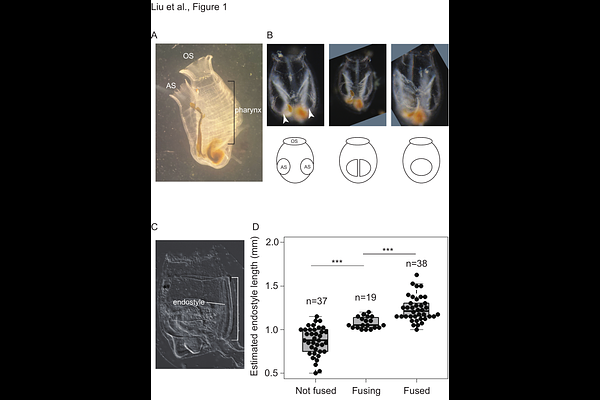
AbstractThe hallmark of sessile adult ascidians is a vase-like shape with a single oral and atrial siphon. Ciona, however, develops two atrial siphons after metamorphosis, which subsequently fuse into one. The mechanisms underlying this fusion are unknown. This study suggests that Hox2 controls this process. Hox2-knockout animals using Transcription-Activator-Like Effector Nuclease (TALEN) retain two atrial siphons throughout their lives. During normal fusion, epidermal cells between the siphons flatten along the anterior-posterior axis. This cellular flattening does not occur in Hox2-knockout animals, suggesting that the shape change in the epidermal cells produces tension, allowing the atrial siphon openings to converge at the midline for fusion. Hox2-knockout animals lack cupular organs, which are suspected hydrodynamic sensors in the internal epithelium of the fused atrial siphon and on the sperm duct. Among several knockout attempts, atrial siphon fusion was reproduced by only one TALEN pair, suggesting that this phenotype is driven by a mutation having a broader effect than those abolishing protein function. Many ascidians, unlike Ciona, develop a single atrial siphon shortly after metamorphosis. Our findings suggest that a phylogenetically conserved gene, Hox2, establishes this group-specific atrial siphon formation mechanism in Ciona.