Demographic compensation buffers population decline under variable grazing intensities in alpine grasslands

Demographic compensation buffers population decline under variable grazing intensities in alpine grasslands
Miao, H.-T.; Li, S.-L.
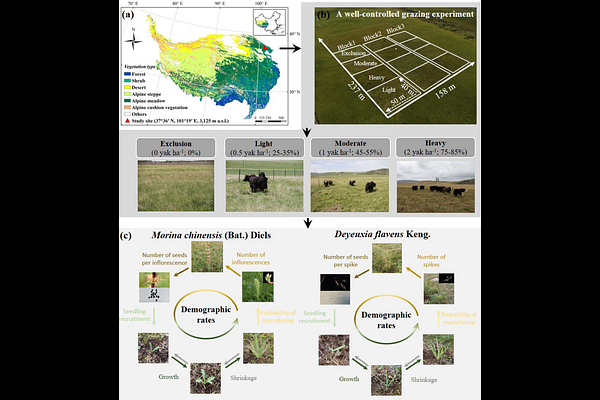
AbstractIdentifying optimal grazing intensities for sustainable population growth is crucial for informing management strategies. Community-level studies frequently find that biodiversity peaks at intermediate grazing intensities, known as the 'Intermediate Disturbance Hypothesis'. However, whether this hypothesis applies to population-level performance remains untested. Our stochastic integral projection models, parameterized with five-year demographic data of two co-occurring species, Morina chinensis and Deyeuxia flavens, on the Tibetan Plateau grasslands, indeed show a hump-shaped response in stochastic population growth rate ({lambda}S) to grazing intensities, providing empirical support for the 'Intermediate Disturbance Hypothesis' at population level. Furthermore, populations with demographic compensation among vital rates are better able to buffer temporal variation in annual population growth rate and exhibit a much smaller decline in {lambda}S under heavy grazing. Our study provides mechanistic insights into demographic processes driving population dynamics across grazing levels, thereby better informing grazing management strategies.