Evolution of mutational fitness effects in island populations

Evolution of mutational fitness effects in island populations
Howell, E. K.; Nolfo-Clements, L. E.; Baier, F.; Payseur, B. A.
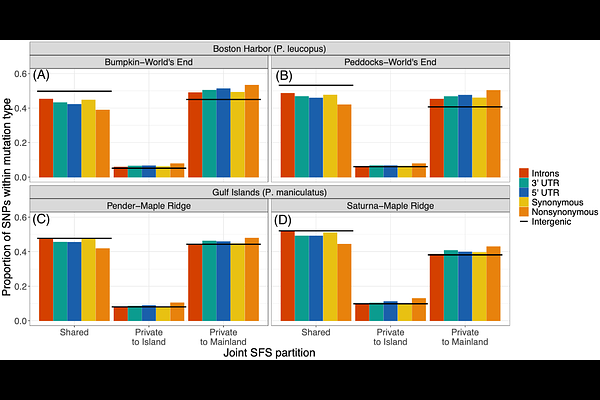
AbstractThe distribution of fitness effects (DFE) quantifies the selective consequences of newly arising mutations. Theoretical and empirical investigations of the DFE suggest that it is highly context-specific, shaped by both intrinsic properties of an organism (e.g., biological complexity) and extrinsic properties of a population (e.g., environment). Despite recent comparisons of the DFE between populations and species, little is known about how this distribution changes over shorter evolutionary timescales. Islands provide a powerful framework for understanding the impact of recent shifts in selection on the DFE, as founding populations often experience abrupt environmental changes. Using whole-genome, population-level sequence data, we investigate how such extreme transitions shape the DFE in two island radiations of Peromyscus mice: white-footed mice (P. leucopus) in Massachusetts's Boston Harbor and deer mice (P. maniculatus) in the Gulf Islands of British Columbia. To measure the extent to which the selective effects of mutations have diverged between island and mainland populations, we leverage recent advances that extend DFE inference to multiple populations. By reconstructing the "joint DFE", we estimate both the strength of selection acting on distinct mutational classes and the correlation in mutational fitness effects between populations. We find that mutational fitness effects have diverged between island and mainland populations, despite the relative recency of these radiations. Comparisons between island populations, which reveal higher fitness effect correlations, suggest that this feature of the joint DFE captures broad-scale divergence in the environment populations inhabit. Together, our discoveries provide a rare empirical example of divergent environments shaping genome-wide patterns of fitness-affecting genetic variation in natural populations.