Acorn-omics: Optimal Foraging Behaviour Generates Steep Discounting and Preference Reversals in Laboratory Tasks

Acorn-omics: Optimal Foraging Behaviour Generates Steep Discounting and Preference Reversals in Laboratory Tasks
Burnham, Y. L.; Fawcett, T. W.; Leaver, L. A.; Higginson, A. D.
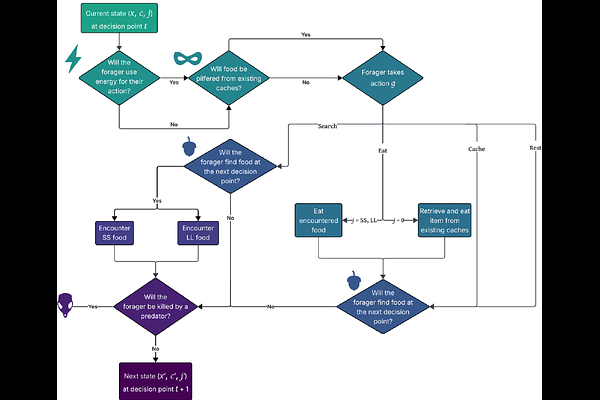
AbstractClassic foraging models and discounting tasks may oversimplify the decision-maker's environment, resulting in a discrepancy between predicted and observed behaviour. In delay discounting tasks, animals typically steeply devalue larger-later (LL) outcomes, choosing smaller-sooner (SS) rewards after short delays. This steep discounting appears to be irreconcilable with natural foraging behaviour, where animals frequently endure long delays when travelling to find food, handling tough items, and storing food for future use. This apparent mismatch in behaviour has led to questions regarding the ecological validity of laboratory discounting tasks. Here, we developed a rich dynamic optimisation model to identify the conditions under which animals should choose LL or SS outcomes. In our model, a food-storing animal encounters food items differing in energy content and handling time and must decide which items to eat immediately and which to cache, so that it has enough stored food to survive winter. We simulated a range of environments, including laboratory conditions where foragers face negligible predation risk when searching for food and have a high probability of finding food, compared to more natural conditions where searching for food is risky, and food is harder to find. In line with preference reversals seen in the discounting literature, our model predicts that LL items should be rejected more often when the handling time for such items is increased, whereas SS items should be rejected more often when the handling time for both items is increased. Importantly, our model only predicts rejection of food items under parameter values that reflect laboratory conditions, supporting the notion that the steep devaluation of rewards seen in animals may be driven by the artificiality of traditional discounting tasks.