Genome-wide association analysis reveals new loci for leaf water status, biomass and plant architectural traits in bread wheat under rainfed conditions

Genome-wide association analysis reveals new loci for leaf water status, biomass and plant architectural traits in bread wheat under rainfed conditions
Rustamova, S.; Jahangirov, A.; Gurbanova, U.; Khudayev, F.; Leon, J.; Naz, A. A.; Huseynova, I.
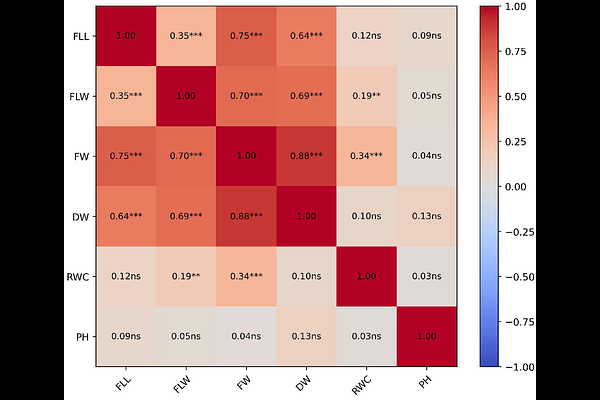
AbstractDrought during reproductive development and grain filling is a major constraint to bread wheat productivity in rainfed environments. In the present study, we employed ge-nome-wide association analysis in an untapped diversity panel of wheat genotypes rele-vant to natural dryland conditions. A total of 186 genotypes were evaluated for drought-related physiological, biomass, and architectural traits under terminal rainfed stress in Azerbaijan. Relative water content, plant height, fresh weight, dry weight, flag leaf length, and flag leaf width were assessed at the milk ripening stage. These data were subjected to genome-wide association analysis using 19,737 SNP markers to identify loci and epistatic interactions involved in the determination of these traits. The panel showed broad phenotypic variation and significant genotypic effects for all traits, with broad-sense heritability ranging from 0.991 for plant height to 0.385 for flag leaf width. GWAS identified a major locus for relative water content on chromosome 2D at SNP marker AX-86184518, which explained 11.94% of the genotypic variation. Candidate-gene analysis highlighted the proximal WEB-family-like gene TraesCS2D03G1001000 as the main candidate gene. Plant height showed strong additive loci, mainly on chromosomes 2A and 4A, whereas biomass and flag leaf traits showed suggestive additive loci and epi-static interactions. These findings provide candidate loci and interaction patterns in the genetic make-up of essential traits, which may facilitate indirect selection in breeding new varieties.