Genotype-Driven Carbon Sequestration And Soil Fertility Restoration In Coastal Agroforestry Systems: A Mechanistic Evaluation Of Nutrient * Genotype Interactions

Genotype-Driven Carbon Sequestration And Soil Fertility Restoration In Coastal Agroforestry Systems: A Mechanistic Evaluation Of Nutrient * Genotype Interactions
SAHU, P.; NAYAK, M. R.; NAYAK, J.
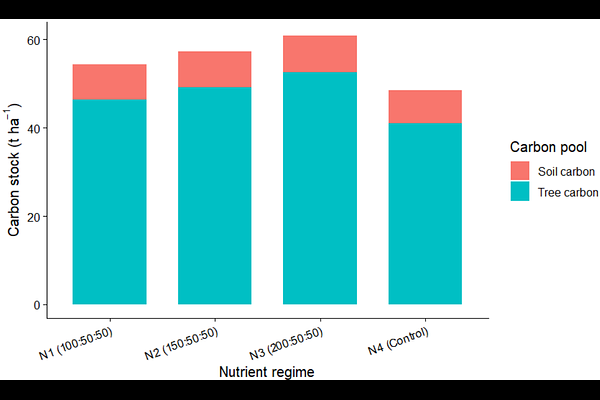
AbstractCoastal agroecosystems are critical yet fragile carbon sinks, often limited by severe soil degradation and nutrient leaching. While agroforestry is a proven strategy for soil restoration, the role of intercrop genotype-level variation in regulating system-wide carbon sequestration remains poorly understood. This study evaluated a coastal guava (Psidium guajava L.) agroforestry system in Odisha, India, to determine how the interaction between three brinjal (Solanum melongena L.) genotypes and graded nutrient regimes influences carbon partitioning and soil health. Our results demonstrate that carbon sequestration is governed by a significant Genotype x Nutrient interaction. The "Utkal Madhuri" genotype emerged as a superior biological regulator, maximizing total system carbon stocks to 59.49 t ha-1 and sequestration rates to 19.83 t ha-1 yr-1. Simultaneously, optimized fertilization (200:50:50 kg ha-1 N:P2O5:K2O) increased soil organic carbon to 0.47% and significantly improved bulk density without inducing soil acidification. These findings reveal that intercrop genetic selection is as vital as chemical inputs for climate mitigation. Integrating high-performing genotypes with optimized nutrient regimes provides a scalable framework for restoring fertility and enhancing carbon sinks in vulnerable coastal landscapes.