Preventing Disease Emergence Following Eradication: Application to Mpox

Preventing Disease Emergence Following Eradication: Application to Mpox
Hirst, C.; Deichmann, J.; Saha, A.; Longini, I.; Handel, A.; Lipsitch, M.; Weissman, D.; Antia, R.
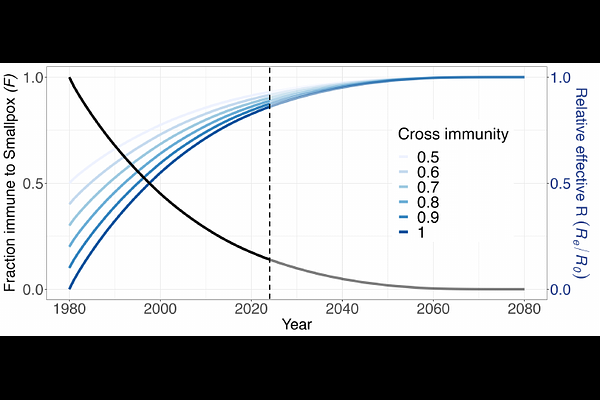
AbstractWe use simple mathematical models to explore the factors that influence the evolutionary emergence of mpox to a pathogen capable of sustained human to human transmission that poses a global threat. Smallpox eradication followed by the discontinuation of immunization with vaccinia has led to a decline in the level of population immunity against related poxviruses such as mpox. This decline in immunity results in an increase in both the number of spillovers and the extent of human to human transmission. We find that increases in transmissibility of mpox between humans have a much greater effect on the probability of evolutionary emergence compared with increases in the number of zoonotic spillovers. We suggest that while mpox only needs to have a reproductive number slightly greater than one to become endemic, subsequent adaptation is likely to further increase its transmissibility in the human population. As a consequence a much higher level of vaccination (or other intervention) is needed to control the pathogen after its evolutionary emergence compared with what is needed to prevent it from emerging in the first place.