Unique mushroom spine morphology signature in cocaine relapse ensembles in rat nucleus accumbens core

Unique mushroom spine morphology signature in cocaine relapse ensembles in rat nucleus accumbens core
Rubio, F. J.; Ukpong, E.; Madangopal, R.; Olivares, D.; Hilaire, E.; Henry, A.; Kelly, A.; Kane, L.; Mejias-Aponte, C.; Hope, B. T.
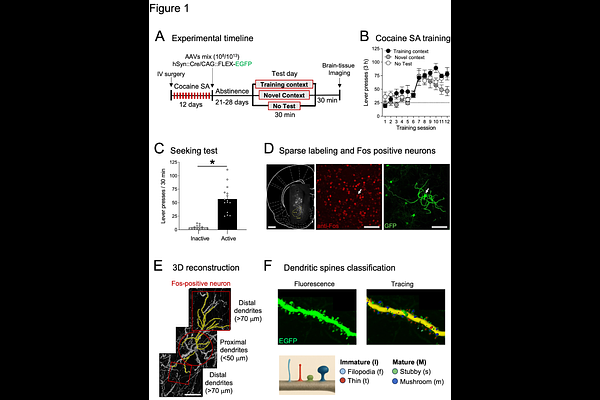
AbstractFos-expressing neuronal ensembles in nucleus accumbens (NAc) are selectively activated by drug-associated cues and shown to play a causal role in drug-cue memories. Many unique molecular and cellular alterations have been identified in these ensembles and thought to be components of an engram encoding the memory; however, spine morphology alterations on these ensembles have rarely been examined. Here, we examined alterations of identified spine types on Fos-expressing neurons in NAc core that were selectively activated by drug-associated cues during cocaine relapse. We combined Fos immunolabeling along with viral-based sparse GFP labeling to identify Fos-positive and Fos-negative neurons with distinguishable dendrites and quantified spine composition, densities and interspine intervals (ISIs) for all spine types, and head and neck diameters of mushroom spines. ISIs and head and neck diameters of mushroom spines were altered on Fos-positive (versus Fos-negative) neurons activated during cue-induced cocaine relapse. Critically, these alterations were not found on Fos-positive neurons activated by exposure to a novel context on relapse test day, despite having identical cocaine self-administration histories. Based on previous work, this suggests these alterations were not simply due to acute activation of a randomly selected set of neurons on test day, but rather they were altered specifically on neurons selectively activated during cocaine self-administration training and then reactivated during relapse. Stubby spines and immature spines, including filopodia and thin spines, were not altered. Altogether, these mushroom spine alterations describe a unique spine morphology signature for a drug-cue memory in NAc neuronal ensembles selectively activated during cocaine relapse.