Cortical Layer 6b Persistent Subplate Neurons Reciprocally Connect Sensorimotor Areas and Inversely Reflect Somatosensory Engagement

Cortical Layer 6b Persistent Subplate Neurons Reciprocally Connect Sensorimotor Areas and Inversely Reflect Somatosensory Engagement
Khalid, R.; Masini, D.; Locarno, A.; Netsyk, O.; Lorentz, J.; Broberger, C.
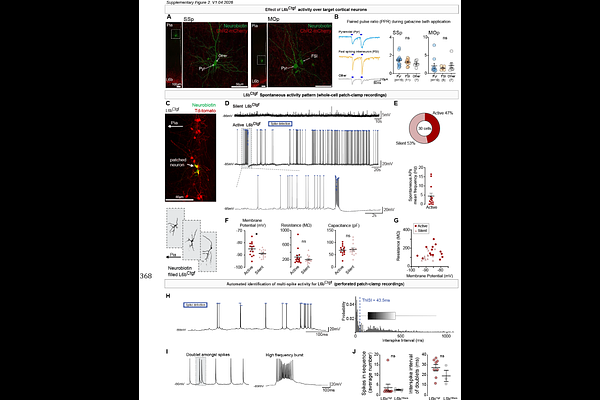
AbstractPersistent subplate neurons in layer 6b (L6b) of the cerebral cortex have long been assumed to be a passive remnant of early development. Recent findings are challenging this concept, but the functional role of L6b remains mysterious. A large group of L6b neurons express Connective Tissue Growth Factor (Ctgf). Here, we mapped L6b-Ctgf neurons throughout the cortex and found the highest density in primary sensorimotor areas. Cortical L6b-Ctgf projections are ipsilaterally restricted and origin-site specific, with notable reciprocity, whereas innervation of the thalamus is modality-matched. L6b-Ctgf neurons are electrically diverse and form excitatory synapses with both pyramidal cells and interneurons. In freely moving mice, these neurons are highly active and have prominent task-specific and temporally locked responses to external stimuli. These responses are dominated by paradoxical population silencing with escalating task engagement. Thus, L6b-Ctgf neurons may keep cortical ensembles in a state of alertness and available to process cognate stimuli.