Organization and evolution of sex-biased gene expression in Drosophila adult sexual circuits

Organization and evolution of sex-biased gene expression in Drosophila adult sexual circuits
Chen, D. S.; Gifford, H.; Kurmangaliyev, Y. Z.; Ding, Y.
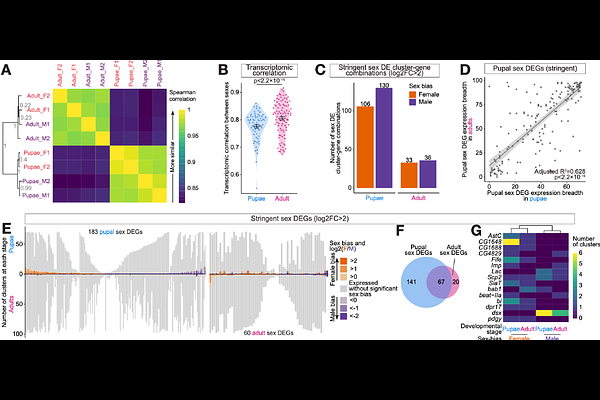
AbstractSexually dimorphic behaviors are widespread across animals. A key open question is how the underlying sexual circuits, which encode these behaviors, evolve to meet sex-specific fitness needs despite being built from largely shared developmental blueprints. Here, we use single-cell transcriptomics, leveraging the sex determination gene fruitless (fru) as a molecular handle, to examine the transcriptomic landscape and evolution of adult Drosophila sexual circuits at cellular resolution. We find that sex-biased gene expression is limited, highly cell-type-specific, and largely species-specific. Species divergence in gene expression is widespread and predominantly coupled between sexes, with sex-specific changes constrained by pleiotropic gene expression across cell types. Furthermore, a strong overlap of differentially expressed genes across sexes, species, and fru status points to a common set of genes, particularly neural signaling genes, whose expressions are highly labile across multiple contexts. Finally, transcriptomic divergence between sexes decreases from mid-pupae to adulthood, underscoring the developmentally dynamic nature of sex-biased gene expression. Our results provide fundamental insights into the organization and evolutionary mode of sex-biased gene expression, suggesting that sex-specific adaptation via selective gene programs at localized circuit nodes is a key mechanism that preserves circuit evolvability despite pervasive transcriptomic coupling between sexes.