Ultrafast light sensing mediated by dermal iridophores in the silverside fish Hypoatherina tsurugae

Ultrafast light sensing mediated by dermal iridophores in the silverside fish Hypoatherina tsurugae
Iwasaka, M.
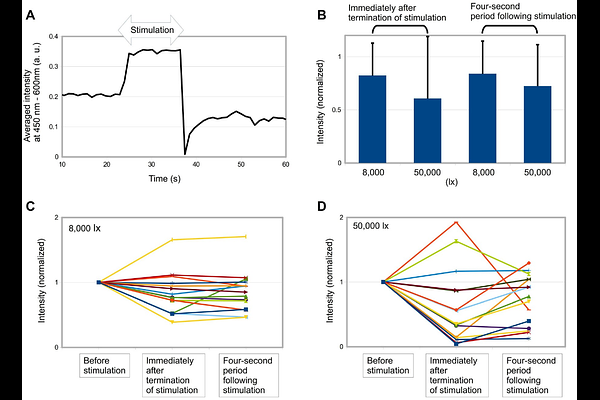
AbstractLight-induced body color changes and direct optical sensing in the skin of amphibians and fishes have been debated for more than half a century. Previously reported chromatophore-mediated photoresponses generally occur on timescales of tens of seconds to minutes and are commonly attributed to intracellular molecular mechanisms, including opsin-dependent signaling pathways. In several invertebrates and amphibians, dermal photoreception has been detected electrophysiologically as rapid neural outputs. Here, I report an ultrafast, nonvisual photoresponse mediated by dermal iridophores in the silverside fish Hypoatherina tsurugae (Atherinidae). Upon exposure of living skin to white LED illumination, the light reflection from iridophores was rapidly quenched within seconds. Spectral analysis revealed that this quenching response was most sensitive to blue light compared with green and red illumination. The reflected light recovered to its original twinkling state within approximately 10 s after cessation of illumination. The speed and reversibility of this response suggest that mechanisms beyond slow intracellular structural rearrangements are involved and raise the possibility of neural modulation in addition to intrinsic photoreceptive processes. These findings uncover an unrecognized mode of dermal light sensing and provide insight into bioinspired design principles for artificial optical sensing skins.