Striatal and frontal signatures of social context and cost-benefit decision making in developmental stuttering

Striatal and frontal signatures of social context and cost-benefit decision making in developmental stuttering
Neef, N. E.; Winter, E.; Obrig, H.; Neef, A.; Mildner, T.; Haj Mohamad, S.; Riedel, C. H.; Scholze, K.
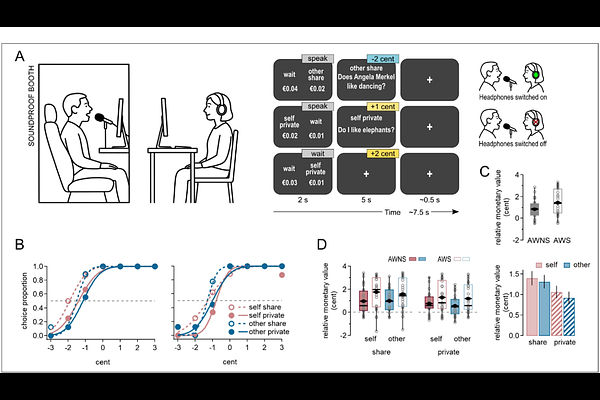
AbstractBackground: Developmental stuttering is usually framed as a sensorimotor disorder, yet it manifests in communicative situations that engage motivational, self-referential, and regulatory processes. Methods: In this case-control study, we combined a socio-economic decision task outside the scanner with a socially modulated speech task during fMRI to test how listener presence and self-referential speech shape neural activity in 34 adults who stutter and 32 controls. Results: Both groups valued talking with another person about themselves more than talking with another person about someone else or talking to themselves. On the neural level, listener-directed (vs. private) speech and self-disclosure (vs. guessing the preferences of a famous other) elicited stronger responses in the ventral striatum and medial prefrontal cortex, extending social valuation effects previously reported in fluent speakers to adults who stutter. Within the stuttering group, individual differences revealed a systematic reweighting of socially modulated activation as a function of symptom burden: higher anticipation of stuttering and greater overall impact were associated with stronger engagement of motivational circuitry, greater recruitment of frontal evaluative-control regions, and reduced contextual differentiation within speech-language cortex. Conclusion: Stuttering anticipation and lived experience gradually shift the balance between control, language, and motivational salience-processing systems, contributing to the disorder's marked heterogeneity and context sensitivity. These findings indicate system-level signatures of the interaction between social context and symptom severity, rather than isolated motor deficits, in developmental stuttering. More generally, they reveal how recurrent experiences shape brain activity through the interplay between language, motivational and control systems that governs human social interactions.