Phenotypic plasticity as a route to population shifts via tipping points

Phenotypic plasticity as a route to population shifts via tipping points
Fellows, B.; White, S.; Brass, D.; Nascou, A.; Cobbold, C.
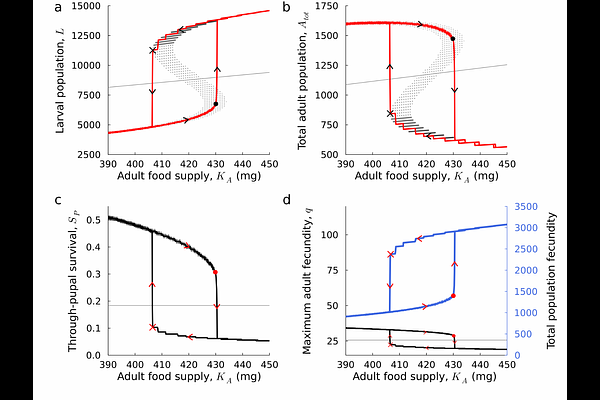
AbstractEnvironmental change has caused dramatic global declines in biodiversity, with some species showing abrupt and often irreversible changes in population abundance. These regime shifts can occur when environmental thresholds, known as tipping points, are passed. Many species can respond to environmental change via phenotypic plasticity with the expectation that strong phenotypic plasticity reduces the risk of regime shifts by enabling a species to rapidly respond to environmental change, potentially mitigating the risks of population collapse. Testing the theory that phenotypic plasticity buffers against regime shifts requires a novel whole population approach that robustly considers the feedback mechanisms between environment, phenotype and population density, common to the life-history of many species. For this purpose we develop a tractable mathematical framework, and demonstrate, counter-intuitively, that phenotypic plasticity can induce tipping points, due to the inclusion of feedback mechanisms that operate at both the level of the organism and population. Consequently, predicting the existence of potentially devastating tipping points and so understanding ecosystem collapse is more nuanced than current thinking suggests.