Land-use influence on benthic algal assemblage structure and biomass in Afrotropical headwater streams

Land-use influence on benthic algal assemblage structure and biomass in Afrotropical headwater streams
Rioba, S. N.; Iteba, J. O.; Kuluo, G. L.; Jacobs, S. R.; Breuer, L.; Masese, F. O.
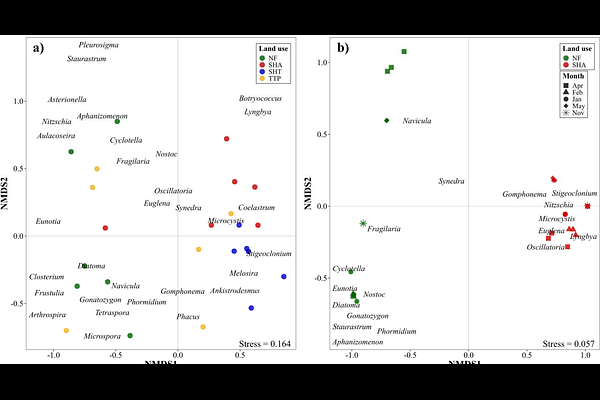
AbstractBenthic algae integrate catchment- and reach-scale pressures in streams. We assessed land-use effects on benthic algal assemblage structure, chlorophyll-a, ash-free dry mass (AFDM), and autotrophic index across 24 headwater streams in the Sondu-Miriu River basin, Kenya, and explored wet-dry patterns in two monitoring streams. We sampled across four land-use categories: natural forest (NF), tea and tree plantations (TTP), smallholder agriculture (SHA), and smallholder tea (SHT). Synoptic sampling occurred in August 2025, and one NF stream and one SHA stream were sampled five times between November 2024 and May 2025. Shannon and Simpson diversity were highest in NF streams and lowest in SHT streams. Chlorophyll-a and AFDM were highest in SHA streams; chlorophyll-a was lowest in SHT, while AFDM and autotrophic index were lowest in NF. Relative abundance patterns showed that SHA streams were dominated by Lyngbya and Stigeoclonium, whereas SHT streams were dominated mainly by Stigeoclonium; NF streams supported persistent diatom-rich assemblages. Non-metric multidimensional scaling showed land-use separation of benthic algal assemblages, while redundancy analysis indicated weak, non-significant evidence of environmental associations in the synoptic dataset. Composition and biomass metrics tracked land-use gradients and wet-dry patterns, supporting periphyton-based bioassessment for monitoring disturbance in Afrotropical headwater streams.