Slow-Rate Temporal Sampling Deficits During Naturalistic Speech Listening in Children with Developmental Language Disorder

Slow-Rate Temporal Sampling Deficits During Naturalistic Speech Listening in Children with Developmental Language Disorder
Keshavarzi, M.; Feltham, G.; Richards, S.; Parvez, L.; Goswami, U.
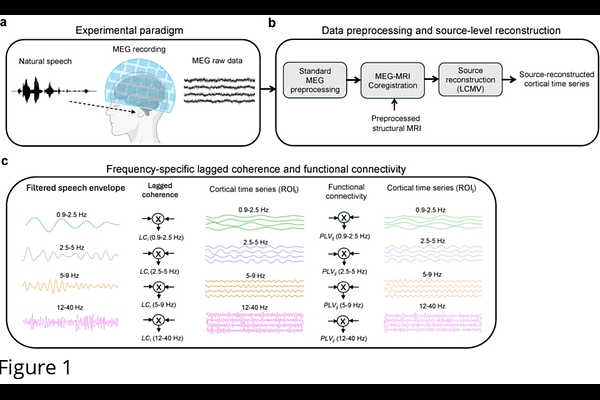
AbstractNeural tracking of slow temporal modulations in speech supports extraction of prosodic and syllabic structure critical for speech comprehension, yet whether these automatic cortical tracking mechanisms are altered in children with developmental language disorder (DLD) remains unclear. We recorded MEG while children with and without DLD listened to a story, and quantified source-level lagged speech-brain coherence and frequency-specific cortical functional connectivity across bilateral cortical regions. Children with DLD showed significantly reduced coherence in the 0.9-2.5 Hz range associated with prosodic information in the story, spanning bilateral auditory and speech-related cortex. In the 2.5-5 Hz range, linked to syllabic-rate modulations in the story, group differences were right-lateralised. No reliable differences were observed at higher modulation rates (5-9 Hz or 12-40 Hz). These coherence reductions were accompanied by altered functional connectivity between cortical regions across all frequency bands, indicating disrupted large-scale coordination within speech-processing networks in DLD.