Transcranial direct current stimulation combined cognitive training modulates risk-taking behavior in older adults

Transcranial direct current stimulation combined cognitive training modulates risk-taking behavior in older adults
Ren, P.; Gong, Y.; Ma, M.; Fu, Y.; Zhuang, Y.; Wu, D.; Zhang, L.
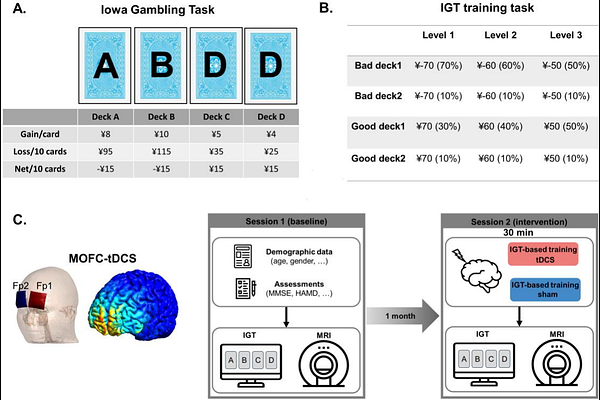
AbstractRisk-taking behavior is a complex cognitive function that often declines with aging, contributing to impaired decision-making and reduced quality of life. While transcranial direct current stimulation (tDCS) has shown promising effects in modulating cognitive function, its influence on ecologically valid, complex behaviors like risky decision-making in older adults remains poorly understood. We investigated whether a single-session stimulation over the medial orbitofrontal cortex (MOFC) combined with cognitive training could enhance decision-making in healthy older adults. In a randomized, sham-controlled study, bilateral MOFC stimulation (left/anode, right/cathode) was applied during a training task based on the Iowa Gambling Task. Pre- and post-intervention assessments utilized conventional behavioral measures and the Values-Plus-Perseveration computational model, alongside task-related fMRI to examine MOFC network changes. Compared to sham, tDCS significantly enhanced the ability to distinguish advantageous from disadvantageous options. Modeling analysis revealed stimulation-induced changes in multiple latent components, such as learning rate, loss aversion, and perseveration decay. Generalized Psychophysiological Interaction analysis showed that tDCS reconfigured the MOFC network by reducing fronto-frontal hyper-connectivity and enhancing fronto-striatal connectivity. These behavioral improvements were specifically associated with the left MOFC network targeted by anodal stimulation. Our results provide causal evidence that tDCS can mitigate age-related impairments in risk-taking by reconfiguring MOFC-related networks. These findings advance the mechanistic understanding of tDCS in aging and highlight its potential as an intervention to prevent age-related decline in decision making.